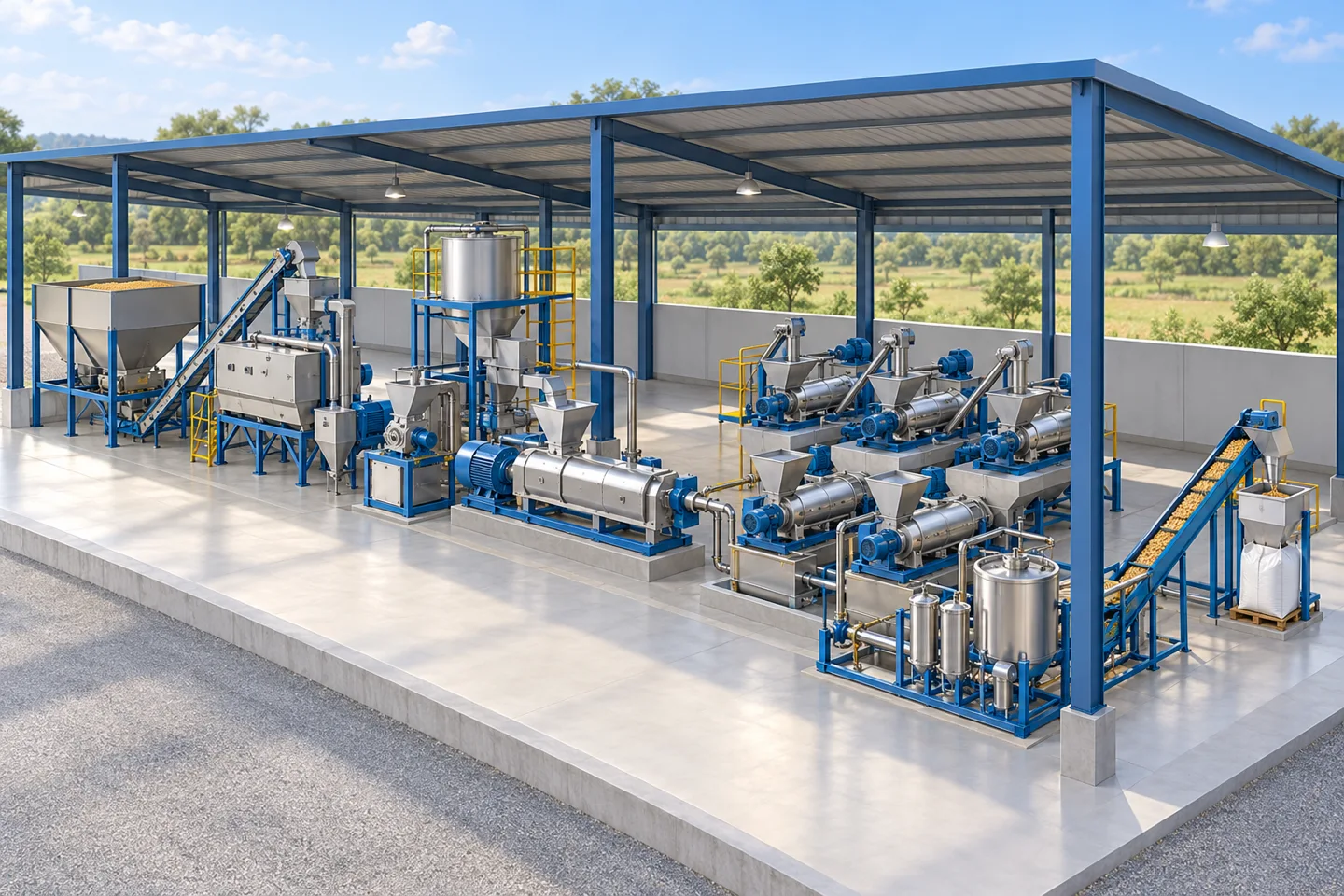
Representative plant concept. Equipment arrangement and building design are developed for the final project.
A 50 TPD soybean oil pressing plant processes 50 metric tons of soybeans in 24 hours. This extrusion-expelling line combines seed cleaning, crushing, dry extrusion, screw pressing, crude-oil filtration and cake cooling. Its two outputs are filtered crude soybean oil and press cake.
50 tons / daySoybean input, on a 24-hour basis
Dry extrusionPreparation before screw pressing
Mechanical pressingNo solvent extraction in this route
Oil + press cakeTwo product streams to handle
A practical starting point for your soybean mill
This configuration is for investors planning to process soybeans into filtered crude oil and press cake. It connects raw-material preparation with pressing, oil collection and cake finishing.
Use it as a basis for equipment selection and layout discussions. Seed condition, working hours, storage needs and the required oil specification determine the final design.
A coordinated package, with receiving and storage sized for your supply schedule. Model selection and quantities are confirmed during engineering.
Process area
Typical equipment
Selection basis
Receiving & cleaning
Feed bin, conveyors, elevators, magnetic separator, cleaning screen, destoner and dust collection
Seed impurity level, intake hours and storage buffer
Crushing & extrusion
Soybean crusher, metered conveying and a dry extruder
Reference: one extruder rated around 2.5 t/h; verify capacity with the actual seed
Mechanical pressing
Distribution conveyor and a bank of screw oil presses
Reference: six presses rated 8–10 t/day each. Confirm combined soybean throughput and downtime allowance for the 50 t/day duty
Oil collection & filtration
Oil-residue handling, crude-oil pumps, filters and holding vessels
Oil flow, solids loading and required filtration duty
Cake finishing
Conveyors, cake crusher, cooler and bagging equipment
Cake temperature, particle size and packaging needs
Electrical & controls
Motor control, field instruments and interlocks; PLC automation can be specified
Local supply, operator requirements and agreed automation scope
Match cleaning capacity to your receiving schedule. The reference design uses a larger 200 t/day cleaning section with storage. This is an optional front-end arrangement—not the capacity of the 50 t/day pressing line. The cleaning section can be reviewed to suit your intake plan.
50 tons per day: match capacity to your working hours
The quoted daily capacity uses 24 operating hours. A shorter schedule changes the hourly duty of the whole line, not just the press.
Average soybean input needed to process 50 metric tons per day
Net operating hours / day
Average soybean feed
24 hours
About 2.1 t/h
16 hours
About 3.1 t/h
8 hours
About 6.3 t/h
Calculation: 50 metric tons ÷ net operating hours, rounded to one decimal place. These are average process duties, not equipment ratings; selection must allow for interruptions and maintenance.
How much oil and press cake will the line produce?
A 50 TPD input rating does not establish a fixed oil output. Seed oil content, preparation, pressing performance and losses during oil clarification all affect the saleable quantity.
Use the same moisture basis for input and oil-content data. For a reliable balance, measure impurities, seed moisture, cake mass, residual oil in cake, recovered oil and filtration losses. Confirm the oil and cake targets in the project specification rather than treating all oil contained in the seed as recoverable product.
Filtered crude soybean oil
Filtration removes suspended solids. Degumming and other refining operations are selected separately for the intended oil grade. Reserve oil storage and transfer connections if a refinery will be added.
Press cake retains some oil and differs from solvent-extracted meal. Ask the intended buyer which moisture, protein, residual-oil and heat-treatment quality tests they require before setting the cake specification.
Is extrusion and mechanical pressing the right route?
Consider this pressing line when
Your target is oil and mechanically pressed cake from a coordinated seed-preparation and pressing process.
You want to separate oil without an extraction solvent in the oil-separation stage.
You can assess oil recovery and cake value together against local buyers’ specifications.
Review a different or additional stage when
Your priority is a solvent-extraction route with a different oil-recovery and plant design basis.
You need refined, bottled cooking oil: plan refining and filling downstream.
You need cold-pressed oil: dry extrusion is a heat-treatment route, so the process needs to be reconsidered.
Compare process routes at the soybean oil processing overview. The choice depends on feedstock, product markets and the agreed project scope.
Site layout, utilities and supply scope
Raw material & operating hours
Provide soybean oil content, moisture, impurities and a representative sample. Confirm daily shifts, annual operating days and seasonal intake patterns.
Building & material movement
Share the available plot and workshop dimensions. Plan receiving, storage, equipment access, lifting, maintenance space, oil dispatch and cake loading together.
Utilities & installation
Confirm voltage, frequency, available electrical capacity and any cooling or compressed-air needs. Utility duties and connections follow the final equipment list.
Supply boundaries
Agree the equipment, controls, piping and installation scope. Civil works, site utilities, unloading and local installation resources need a separate responsibility schedule.
Planning refined or bottled oil? This base concept ends at filtered crude oil and handled press cake. Refining, retail filling and solvent extraction are separate scope decisions.
Questions before choosing a 50 TPD line
Does 50 TPD mean 50 tons of soybean oil per day?
No. It is the soybean input capacity: 50 metric tons in 24 hours, or about 2.1 tons per operating hour. Oil output depends on the seed oil content, preparation conditions and residual oil in the cake.
Is the filtered oil ready for retail bottling?
Filtration removes suspended solids; it does not perform the full refining process. The refining and packing route must be selected for the intended oil specification and local food requirements.
Why can the cleaning section be larger than the pressing section?
Raw material may be received and cleaned over fewer hours than the presses operate. Storage provides a buffer. A larger cleaning section does not increase the capacity of the extrusion and pressing section.
Can the line run with fewer daily operating hours?
Yes, but a 50-ton daily target over fewer hours requires a higher hourly capacity. Tell us the planned shifts so the extruder, presses, conveying and filtration stages can be sized together.
Can refinery equipment be added later?
A separate refinery can be planned downstream. Reserve space, oil storage, transfer connections and utilities during the initial layout review; refinery equipment is outside this base pressing concept.
How much land or workshop space is needed for a 50 TPD soybean plant?
There is no single footprint for every 50 TPD line. Receiving and storage volumes, building height, conveyors, maintenance access, oil tanks, cake loading and future refining all change the layout. Send a dimensioned site plan and required storage days for a preliminary arrangement.
What affects the scope of a 50 TPD soybean plant proposal?
The equipment package depends on seed preparation, operating hours, storage, automation and the required oil and cake specifications. Ask for an itemized scope covering equipment, controls, piping, installation support, utilities and optional refining so proposals can be compared on the same basis.
What electricity consumption should I use in my feasibility study?
Request a connected-load list and an estimated operating consumption for the final configuration. Motor ratings in kW are not the same as consumed energy in kWh per ton; the estimate needs an operating schedule and a clearly defined equipment boundary.
Is this a cold-press soybean oil line?
No. This configuration uses dry extrusion before pressing and includes heat treatment. If cold-pressed oil is your target product, discuss a different preparation and pressing route before selecting equipment.
Send your country, soybean condition, daily processing target, working hours and available site dimensions. Include seed test results if available, planned storage days and whether you need crude oil only or a future refining stage. Ask for a process flow, preliminary layout, itemized equipment list and utility schedule for the agreed scope.