
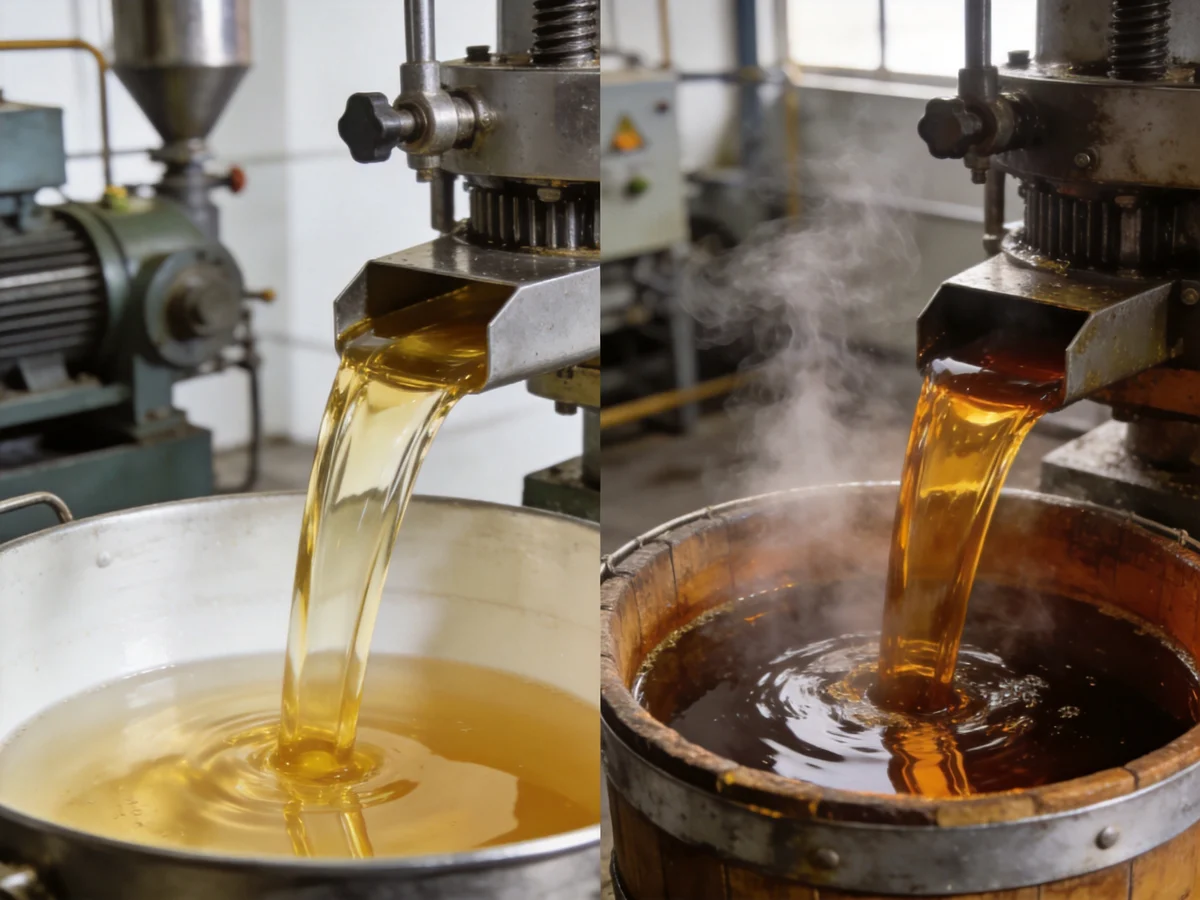
What "Cold Pressed" Really Means
The term "cold pressed" is used differently in marketing versus engineering. Understanding the technical definition protects you from costly misconfigurations — and helps you certify your product correctly.
Cold and hot pressing are two variants of the same mechanical oil pressing process, differing mainly in how much heat the seed receives.
Technical Definition
Oil extracted such that the oil temperature does not exceed 50°C at any point. This applies to: (1) the seed temperature before pressing, (2) the barrel temperature during pressing, and (3) the oil temperature at the collection point. EU organic standards use 27°C for some specific certifications.
Practical Meaning in the Press Room
- The press screw runs at reduced speed (lower RPM = less friction heat generated)
- No pre-heating of seeds — no conditioner or cooker step at elevated temperature
- Press barrel temperature stays below 50°C — monitor with an infrared thermometer at the press outlet
Critical point: A cold press is NOT a different machine — it is a screw oil press operated at reduced speed with no seed pre-heating. The 6YL-130 and 6YL-100 are commonly used for cold-press due to their smaller barrel size and better temperature control, but no specific machine is inherently a "cold press machine." It is the operating parameters — not the equipment model — that determine whether oil qualifies as cold-pressed.
What Hot Press (Expeller Press) Means
Hot pressing is standard commercial oil extraction worldwide. It prioritises yield and throughput, trading some heat-sensitive compound preservation for significantly better extraction efficiency.
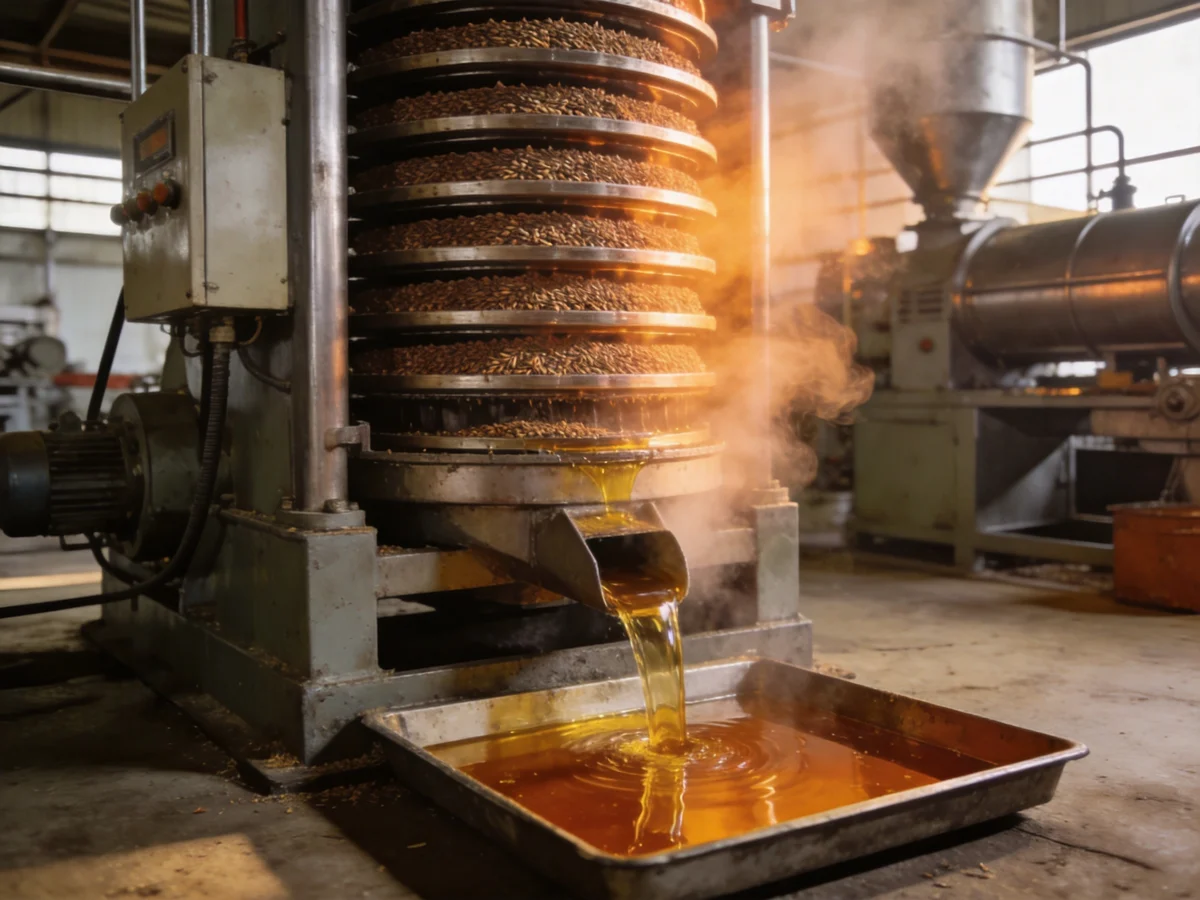
Hot Press Process Sequence
- Seed conditioning / cooking: Seeds heated to 100–110°C, adjusted to 9–12% moisture in a stack cooker or conditioning vessel
- Pressing: Pre-heated seeds fed into the press — barrel temperature 115–130°C
- Oil collection: Oil flows through barrel perforations and is collected in an oil pan below
Why Heat Improves Extraction
The heat serves two distinct purposes that cannot be replicated by cold pressing:
- Extraction efficiency: Heat reduces oil viscosity (easier to flow through perforations), denatures proteins that otherwise bind oil within the seed cells, and ruptures more cell walls for higher oil release
- Flavour development: For roasted peanut oil, toasted sesame oil — the characteristic roasted aroma comes from Maillard reactions at pressing temperature. This is a feature, not a defect
The Temperature Impact — What Changes
Temperature during extraction affects ten measurable parameters. The table below gives concrete data points for each.
| Parameter | Cold Press (<50°C) | Hot Press (115–130°C) |
|---|---|---|
| Oil yield | 60–70% of available | 87–95% of available |
| Residual in cake | 10–20% | 5–8% |
| Vitamin E (tocopherols) | Largely preserved | 10–30% degradation |
| Polyphenols / antioxidants | High — natural levels | Reduced — heat sensitive |
| Oil colour | Light, natural | Darker (Maillard products) |
| Flavour character | Mild, natural seed flavour | Rich, roasted character |
| Shelf life | 12–18 months | 12–18 months refined; 6–8 months crude |
| FFA in crude oil | Similar | Similar (slightly higher if overheated) |
| Refinery needed? | Usually not (for premium market) | Recommended for retail grade |
| Market price | +15–25% vs hot press | Base commodity price |
Yield Comparison — The Numbers
The yield penalty is the central trade-off of cold pressing. Run the actual numbers for your seed before deciding.
Peanut Example: 1,000 kg of Seeds
Peanut oil content: approximately 45%. Available oil = 450 kg.
Cold Press
270–315 kg oil extracted at 60–70% efficiency Remaining cake: 685–730 kg (retains 135–180 kg oil)Hot Press
392–428 kg oil extracted at 87–95% efficiency Remaining cake: 572–608 kg (retains 22–58 kg oil)Yield difference: 77–113 kg less oil per tonne of peanuts when cold pressing. At commercial scale, this is a significant volume that must be offset by premium pricing.
Revenue Comparison: Nigeria Market Example
| Method | Oil Volume (per tonne peanut) | Price/Litre | Revenue |
|---|---|---|---|
| Hot press crude | 380 litres | ₦1,800 | ₦684,000 |
| Cold press premium | 290 litres | ₦2,300 (+28%) | ₦667,000 |
| Cold press (EU export) | 290 litres | ~₦4,200 (+133%) | ₦1,218,000 |
Nigeria commodity market conclusion: A 28% retail premium on cold-pressed peanut oil does NOT cover the 24% yield loss — hot press earns more. Cold press becomes clearly profitable when the price premium exceeds ~35%, which typically requires export markets or certified health/organic retail channels.
Nutritional Difference
The nutritional difference is real — but its practical relevance depends entirely on how the oil will be used.
What Cold Press Preserves
- Tocopherols (Vitamin E): 620 mg/kg in cold-pressed peanut oil vs 480 mg/kg hot-pressed (research average — ~29% higher in cold-pressed)
- Polyphenols: Present in cold-pressed sesame and peanut; mostly destroyed by heat above 120°C
- Phytosterols: Partially preserved in cold press (heat causes some migration to cake)
- Natural antioxidants: Sesamol (sesame), resveratrol (peanut skin), oleocanthal (olive) — all heat-sensitive at >80°C
Practical application: For cooking at high heat (180–220°C), the nutritional advantage of cold-pressed oil is largely irrelevant — the same heat-sensitive compounds are destroyed during cooking regardless of whether they were present at purchase. The nutritional advantage of cold-pressed oil matters most for: salad dressings, drizzling, dipping, cold applications, nutraceutical/supplement use.
Seeds Best Suited to Each Method
Different seeds have different oil compositions, cell structures, and target markets — making one method clearly superior for each.
| Seed | Cold Press | Hot Press | Recommendation |
|---|---|---|---|
| Sesame | Premium cold-press | Dark toasted | Cold for export/health; hot for Asian cooking |
| Peanut | Premium | Standard | Hot for West Africa commodity; cold for EU/US premium |
| Olive | Traditional EVOO | Not common | Hydraulic or centrifuge preferred; cold is essential |
| Black seed (Nigella) | Required | Not suitable | Heat destroys thymoquinone — must be cold-pressed |
| Sunflower | HOSO premium | Standard commodity | Cold for high-oleic specialty; hot for commodity |
| Coconut | Virgin coconut oil (VCO) | RBD grade | Cold (centrifuge) for VCO; hot for RBD coconut oil |
| Soybean | Not practical | Standard | Low oil content (18%) makes cold press uneconomical |
| Cottonseed | Not practical | Standard | Gossypol issues require heat treatment for safety |
| Rapeseed / Canola | Kachi ghani style | Standard commodity | Traditional cold for premium artisan; hot for commodity |
Market Positioning Decision
The right method is determined by your market, not by equipment availability. Map your buyers before configuring your press.
Scenario A: Premium Export / Health Market
- Target: EU, US, premium Asian markets
- Cold press is mandatory — buyers seek certification
- Price premium: 35–60%
- Use 6YL-130 or 6YL-100 with VFD speed control
- Strict temperature monitoring at press outlet
- Certifications: Organic (USDA/EU), HACCP, temperature documentation
Scenario B: Local African / Asian Commodity
- Target: Standard domestic retail market
- Hot press — no meaningful price premium for cold-press
- Use 6YL-160 or 6YL-180 at full speed
- Standard seed conditioning (100–110°C)
- Full batch refinery for retail-grade output
- Cost-efficiency maximises profitability
Scenario C: Split Production (Recommended)
- Cold press first 40% of daily seeds → premium grade
- Hot press remaining 60% → standard commodity
- Two products, two price points
- Requires VFD-equipped press for mode switching
- Maximises total revenue from single press line