
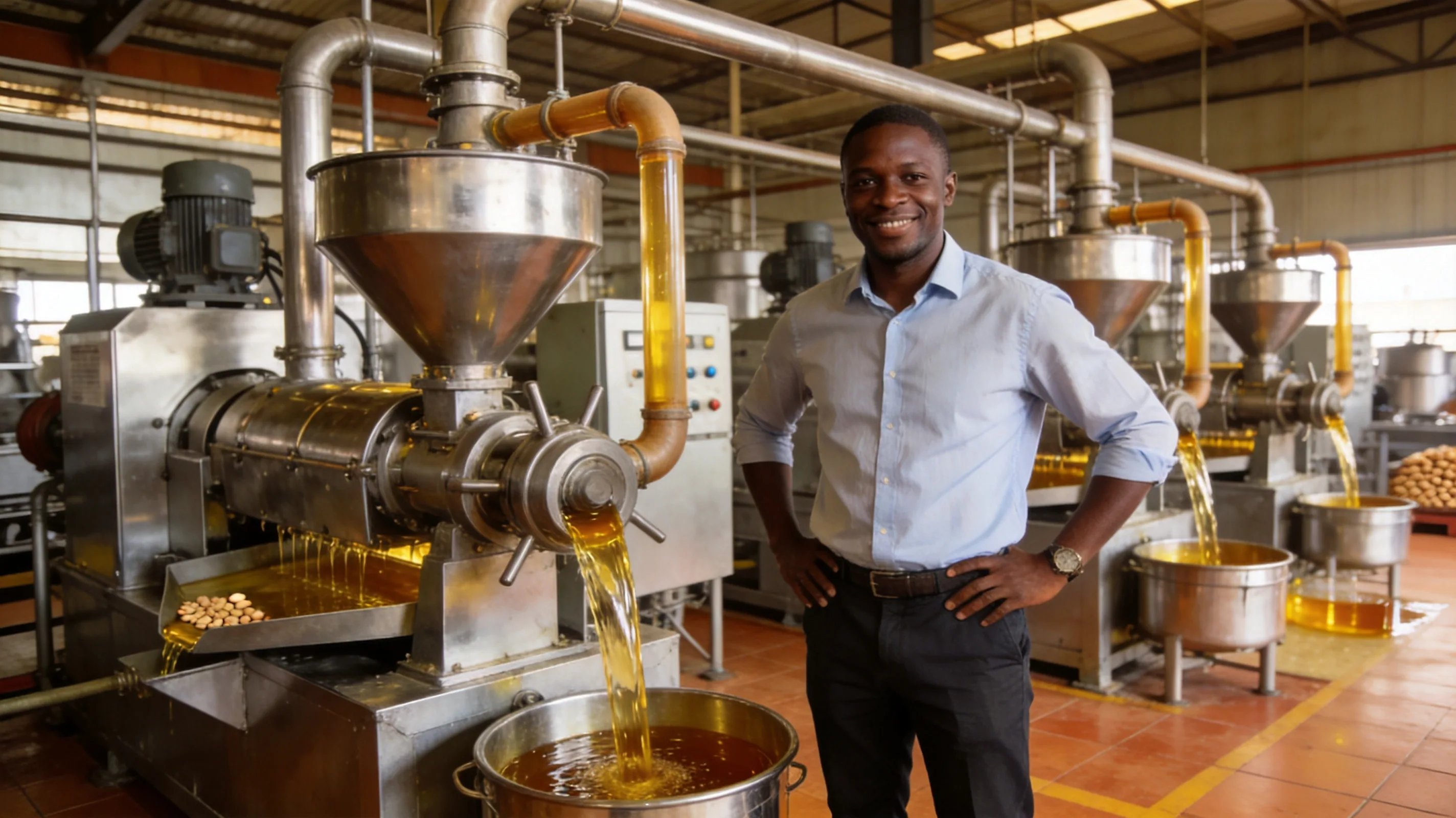
Step 1: Choose Your Raw Material
This single decision determines everything else. Your raw material sets which press model you need, what conditioning parameters to use, whether you need a full refinery, your expected oil yield (and therefore revenue), and your by-product value (protein meal/cake).
Key Selection Criteria
- Local availability: Is there sufficient raw material within 50–80 km of your planned location? Seasonal fluctuation? Year-round supply?
- Oil content: Higher oil content = more revenue per tonne of seeds. Peanut (42–53%) and sesame (45–55%) yield far more oil per tonne than soybean (17–22%).
- Market demand: Is there an established local market for that oil type? What is the local wholesale price?
Recommendation by Region
-
West Africa (Nigeria, Ghana)Peanut/groundnut — abundant supply, strong local market, 42–53% oil yield, proven export potential
-
East Africa (Kenya, Ethiopia, Tanzania)Sesame (Ethiopia), sunflower (Kenya, Zambia), soybean — match to your specific region's crop calendar
-
Middle EastSesame, sunflower, black seed (nigella sativa) for premium niche markets commanding 2–4× commodity price
-
South Asia (India, Pakistan)Mustard/rapeseed, sesame, groundnut — well-established supply chains, strong domestic demand for traditional oils
-
South AmericaSoybean, sunflower, cottonseed — high-volume commodity markets, large industrial-scale operations preferred
Step 2: Assess Your Market
Before buying equipment, verify the demand. This is the most skipped step — and the most important. A $70,000 plant with no confirmed market is a liability. A $20,000 plant with confirmed buyers is a business.
Market Assessment Methodology
- Identify your target buyers: local retailers, food manufacturers, restaurants, other processors
- Find out the current wholesale price of your oil type (per litre/kg) — survey 5+ local buyers
- Calculate what price you can sell at (crude? refined? bottled?)
- Work backwards: target monthly revenue ÷ price per kg = monthly kg output needed
- Convert to daily capacity: monthly kg ÷ 25 operating days = kg/day → TPD
Worked Example: You want ₦2M/month revenue. Local refined peanut oil = ₦1,500/litre. Need: 1,333 litres/month = 44 litres/day = ~55 kg/day refined oil → need ~130 kg/day raw peanut input → approximately 0.13 TPD. Start with a 1–2 TPD mini mill, which gives you 4–6× your initial demand — room to grow without being over-capitalized.
Step 3: Choose Your Scale
Match your capacity to confirmed demand, not to your ambition. It is far better to run a 10 TPD plant at 90% capacity than a 30 TPD plant at 30% capacity. Fixed costs (rent, staff, loan repayments) don't shrink when utilization drops.
| Scale | Capacity | Configuration | FOB China | Total Delivered |
|---|---|---|---|---|
| Mini mill | 1–5 TPD | Press + filter | $5,000–$15,000 | $8,000–$25,000 |
| Small commercial | 5–20 TPD | Press + filter + basic refinery | $18,000–$45,000 | $30,000–$70,000 |
| Medium industrial | 20–50 TPD | Full turnkey | $45,000–$120,000 | $70,000–$180,000 |
| Large industrial | 50–100 TPD | Full continuous | $140,000–$300,000 | $200,000–$450,000 |
Step 4: Select Equipment Configuration
Three configuration levels determine your investment requirement, output quality, and market positioning:
Crude Pressing Only (Press + Filtration)
Lowest investment. Sells crude oil at 20–40% discount to refined. Suitable for: artisan markets, selling to downstream refineries, fast market entry. Add refinery later once cash flow established.
Semi-Refined (Press + Degumming + Basic Neutralizing)
Moderate investment. Better shelf life (12–18 months vs 3–6 months crude). Higher price point. Suitable for bulk restaurant and food service buyers who need stability without full retail grade.
Fully Refined (Full DBDW — Degum, Bleach, Deodorize, Winterize)
Highest investment. Retail-grade output: clear color, neutral taste, 18–24 month shelf life. Required for: supermarket sales, branded retail, food manufacturer supply, export.
Equipment Checklist
- Seed cleaning section (vibrating screen, destoner, magnetic separator)
- Pre-processing (dehulling machine if needed, conditioner/cooker)
- Pressing section (1–6 screw presses depending on capacity)
- Filtration (plate filter press, settling tanks)
- Refinery section (degumming, neutralizing, bleaching, deodorizing — if required)
- Storage (crude and finished oil tanks, nitrogen blanketing)
- Utilities (steam generator, vacuum pump, electrical panels)
Step 5: Site Requirements
Site preparation is consistently the most underestimated cost in oil mill startups. Budget 15–25% of equipment cost for civil works.
| Capacity | Floor Space | Power Required | Ceiling Height |
|---|---|---|---|
| 1–5 TPD | 100–150 m² | ~15 kVA | 4m+ |
| 5–20 TPD | 200–400 m² | 50–80 kVA | 5m+ |
| 20–50 TPD | 400–800 m² | 100–180 kVA | 6m+ |
| 50–100 TPD | 800–2,000 m² | 200–400 kVA | 7m+ |
Critical Site Requirements
- Power: Three-phase supply (380V–415V / 50Hz in most markets). Single-phase is not viable for commercial pressing.
- Water: 0.5–1 tonne water per tonne processed (for refinery cooling and steam generation)
- Foundation: Concrete floor minimum 200mm thick, rated for 5–15 tonnes/m² point load under press equipment
- Drainage: Oil-resistant floor drain required by most food safety regulations
Step 6: Regulatory & Licensing
Requirements vary by country but share a common framework. Critically: start this process when ordering equipment, not after. Regulatory approval typically takes 3–6 months — you don't want your equipment sitting in a warehouse while waiting for permits.
Typical Approvals Required
- Food manufacturing license: NAFDAC in Nigeria, KEBS in Kenya, FSSAI in India, FDA in Ghana, BSTI in Bangladesh
- Environmental / industrial license: NOC (No Objection Certificate) from local environmental authority
- Business registration: CAC in Nigeria, RGD in Ghana, etc.
- Import permits for equipment: Usually industrial machinery is duty-free or low-duty in developing markets
- ISO 22000 or HACCP: Required for export or supplying food manufacturers; not required for local retail in most markets
Practical tip: Engage a local food safety consultant who knows your country's specific licensing process. The $500–$1,500 fee is recovered many times over in time saved and mistakes avoided. Ask your equipment supplier if they have recommended consultants in your country — we maintain a network of partners in 40+ countries.
Step 7: Order, Install & Commission
From contract signature to first commercial oil typically takes 4–8 months. Here is the realistic timeline broken down:
Weeks 1–2: Contract & Deposit
Finalize equipment specification, sign contract, pay deposit (typically 30–40%). Your engineering drawings and layout plan are issued for site preparation.
Months 1–2: Manufacturing
Equipment manufactured, quality-checked, and prepared for shipment. Factory acceptance testing (FAT) available for orders over $50,000. Packing list and shipping documents prepared.
Months 2–3: Sea Freight
25–35 days to Africa, 15–22 days to South Asia, 18–25 days to Middle East. Civil works should proceed in parallel with shipping — this is where you recover timeline.
Months 3–4: Installation
Equipment installation: 7 days (mini mill) to 25 days (full industrial). Our engineers can visit for installation supervision — included for projects above $50,000.
Months 4–5: Commissioning & First Oil
Trial run, parameter optimization, operator training (5–10 days). First commercial oil production. Our fastest project on record: 67 days from order to first oil (Uganda 10 TPD, existing building, fast customs clearance).
Step 8: First Year Operations
The plant is running — now the business begins. The first year is critical for establishing operational discipline and market position.
Raw Material Quality Control
Test incoming seed moisture (optimal 8–12%), check for aflatoxin contamination (critical for peanut), verify oil content on each batch. Reject substandard batches — the short-term cost of rejection is far lower than the yield loss and quality problems from processing poor material.
Maintenance Discipline
Follow the maintenance schedule from day one. Most first-year failures trace back to skipped lubrication and delayed part replacements. Press screw inspection at 500-hour intervals. Filter cloth changes when pressure differential exceeds 0.3 MPa. Gearbox oil change every 1,500 hours.
By-Product Monetization
Press cake/meal adds 15–30% to revenue. Identify buyers before commissioning. For peanut: groundnut cake for livestock feed (high protein, strong demand in West Africa and South Asia). For soybean: soy meal (commodity, price-linked to Chicago Board of Trade). For sesame: sesame cake for livestock/fertilizer.
Working Capital Management
Keep 2–3 months of seed supply budget in reserve. Raw material price fluctuations (driven by seasonal harvest, currency movements, weather) are the largest single risk to oil mill profitability. Never let working capital fall below 1 month of operating expenses.
Quality Testing
Monthly FFA (Free Fatty Acid) and peroxide value tests at a local food laboratory. These two tests together cost $20–$50 and will catch quality problems before they reach customers. FFA above 0.5% in refined oil indicates a refining process issue. Peroxide value above 10 mEq/kg indicates oxidation — check your storage conditions and nitrogen blanketing.
Quick Reference: Investment by Scale
Worked Investment Example (20 TPD Peanut, Semi-Commercial Scale): Equipment FOB $40,000 + Shipping $4,000 + Import duties ~$6,000 + Civil works $8,000 + Working capital (2 months seeds) $15,000 = ~$73,000 total. Monthly gross margin at current Nigerian prices: approximately $8,000–$12,000. Payback period: approximately 7–9 months.