When customers complain that oil foams and boils over in the pan, the cause is gum still in the crude oil. This combo fixes it at the source: a hydration stage mixes warm water into the oil to capture phospholipid gums, then the high-speed centrifuge spins gum and water out — clean, stable, market-ready oil from one machine.
Phospholipids (gums) dissolve in fresh pressed oil and pass straight through ordinary filters. In the pan they absorb water, foam violently and burn dark — the single most common quality complaint small mills face. Hydration exploits the gums' own chemistry: mixed with a little warm water they swell and clump, becoming heavy enough to separate.
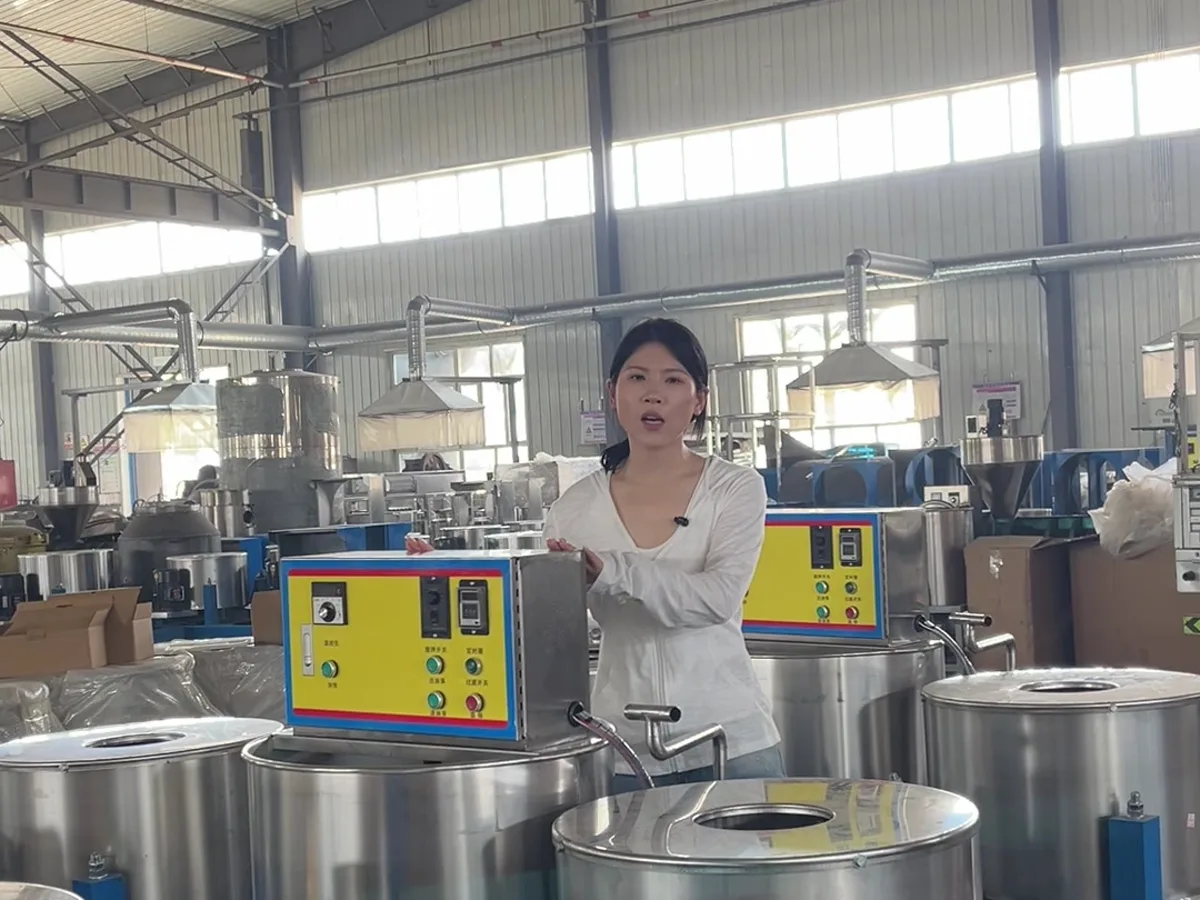
The combo machine does both steps without transfers: hydrate in the upper vessel with adjustable-speed stirring, then spin the batch in the centrifuge bowl. Self-circulating versions automate oil movement with a gear pump; mixing versions give full manual control with twin stainless vessels. Either way, the result is oil that fries quietly and stays clear on the shelf.
| Model | Hourly Output | Heating | Weight | Size |
|---|---|---|---|---|
| Standard combo | ≈150 kg/h | — | 176 kg | 110×66×110 cm |
| New-generation combo | ≈150–200 kg/h | — | — | 120×95×116 cm |
| Self-circulating type | 100–250 kg/h | 2 kW | 200 kg | 110×110×60 cm |
| Mixing type (twin stainless) | 100–250 kg/h | 4 kW | 220 kg | 147×61×90 cm |
Hydration vessel and centrifuge share one frame — no pumping between separate tanks, no waiting, no extra floor space.
Removing phospholipid gum stops the foaming/boil-over problem and keeps oil clear in storage — the complaint-ender for retail oil.
Gear-pump version moves oil automatically through hydrate-and-spin cycles; one operator supervises several machines.
Variable-speed mixing (up to ≈260 rpm on the new vessels) gives full control over water dispersion for different oils.
Twin-vessel mixing version is full stainless on all oil-contact surfaces — food-grade and easy to clean.
Almost always phospholipid gum left in crude pressed oil. Gums absorb moisture and foam when heated. Filtering alone cannot remove them — hydration degumming followed by centrifugal separation can.
A small amount of warm water is stirred into the oil; phospholipids are hydrophilic, so they bind the water, swell into heavy flocs and separate from the oil. The centrifuge then spins the flocs and water out.
Peanut, soybean, rapeseed, sunflower and most pressed edible oils. Water dosage and temperature vary slightly by oil type — operating guidance ships with the machine.
It is the degumming stage — the step that solves foaming and cloudiness for most small mills selling crude-pressed oil. Full refining (deacidification, bleaching, deodorizing) needs a refining machine; many customers add one later.
Self-circulating automates oil transfer for hands-off cycles; the mixing type gives manual control with twin stainless vessels and stronger heating. Output range is the same — choose by how much operator attention you want to spend.
Tell us your raw material, daily capacity and budget — our engineers will recommend the right configuration and send a factory-direct quote within 24 hours.
Contact Us