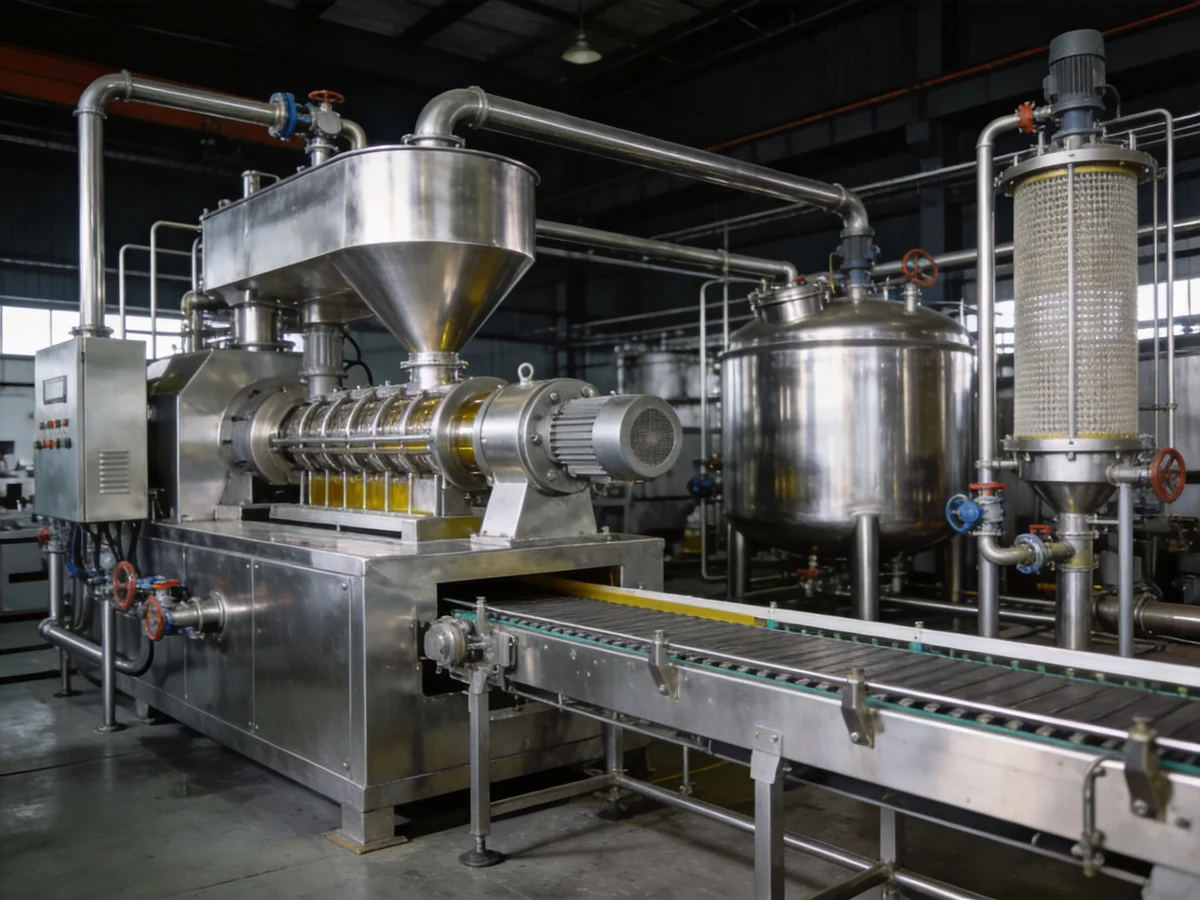
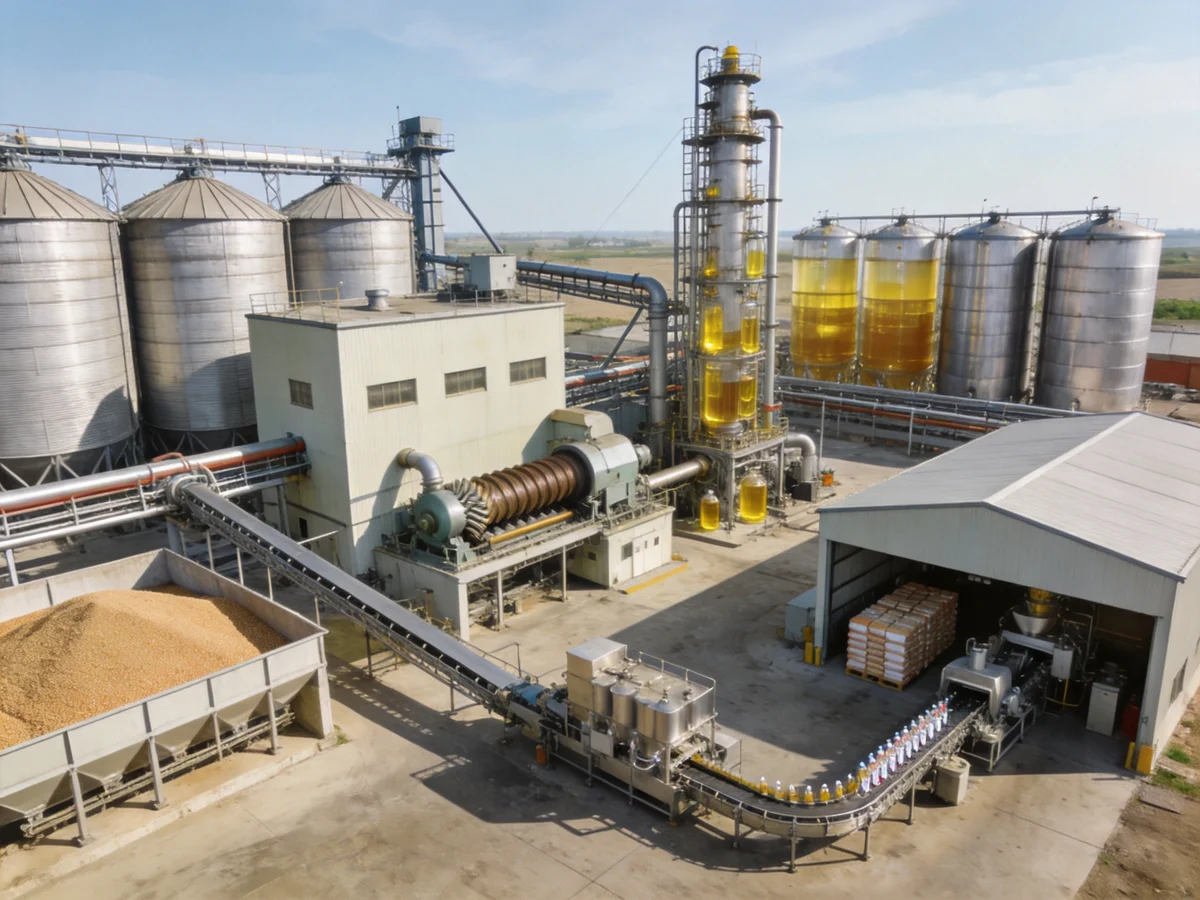
Complete Production Line Overview
The 12-stage flow below shows how raw seed becomes finished bottled oil. Material moves through each stage in sequence — any bottleneck or undersized stage will constrain the entire line's output.
For a neutral, process-by-process explanation of every stage, see the independent Oil Processing Hub process guides.
Stages 1–3: Seed Receiving, Storage & Cleaning
All incoming seed must be tested for moisture, visually inspected for mould, and weighed for inventory control. Store with a 5–10 day buffer (150–500 tonnes for a 30 TPD plant) to protect against supply disruptions.
Removes large debris: straw, stones above 20mm, clumps, packaging material. Typically 2–5% of incoming weight is separated at this stage. Prevents large foreign objects from entering the vibrating screen and causing damage.
Four-step cleaning process ensuring 99%+ clean, metal-free seed reaches the conditioner:
- Vibrating screen (TQLZ80): 3-mesh layer separates by size — oversized, correct-sized, and undersized material
- Destoner (TQSx): Gravity-density separation removes stones (seeds: 0.6 g/cm³, stones: 1.5–2.5 g/cm³)
- Magnetic separator (TCXT25): Removes ferrous metal to <0.5 ppm Fe — critical to prevent press screw damage from nails, wire fragments
- Air aspirator: Pneumatically removes chaff, dust, light material
Stages 4–5: Conditioning & Pressing
Conditioning is frequently underestimated — but correct conditioning can improve press yield by 1–3% while wrong conditioning causes significant yield loss. The conditioner denatures seed proteins (releasing bound oil), reduces oil viscosity, deactivates lipase enzyme (preventing rancidity during processing), and ruptures remaining intact oil cells.
The screw press is the mechanical heart of the plant. At 30 TPD capacity, four 6YL-180 presses run in parallel (each 8–10 TPD, operating 16 hours/day). The press barrel reaches 115–130°C through friction heat and external heating.
Stages 6–8: Crude Oil Handling
Freshly pressed crude oil contains meal fines (0.5–2% by weight) that must be removed before refining. Gravity settling for 2–4 hours removes heavy solids. Plate filter press removes fine particles to <100 ppm suspended solids.
Filtered crude oil is held in nitrogen-blanketed storage tanks as a buffer between the pressing line and refinery. Nitrogen blanketing (<2% O₂ headspace) prevents oxidation and FFA rise during storage. Maximum storage: 2–4 weeks before peroxide value increases significantly.
See the full degumming process in the How to Refine Edible Oil guide. Production line integration note: degumming should follow crude storage without delay — crude oil quality declines with storage time as phospholipids become increasingly non-hydratable.
Stages 9–12: Refining
Stages 9 (Neutralizing), 10 (Bleaching), and 11 (Deodorizing) follow the DBDW sequence documented in full detail in our How to Refine Edible Oil guide. Key integration points for the production line:
Critical sizing rule: Refinery throughput must be sized to handle 110–120% of pressing line crude output. The most common planning error is an undersized refinery that becomes the bottleneck, forcing the pressing line to run at reduced capacity. A 30 TPD soybean press producing 5.5T crude/day needs a minimum 2T/batch refinery running 3 cycles/day (6T/day capacity).
- Heat recovery: Counter-current heat exchangers between Deodorizing (Stage 11) and Bleaching (Stage 10) pre-heat incoming bleached oil — saves 30–40% deodorizing fuel cost
- Nitrogen blanketing: All finished oil storage tanks (SS304) must have nitrogen blanket — mandatory for export-quality shelf life and preventing oxidation
Final polishing filter (0.5–1 μm) removes any remaining micro-particles before filling. Consumer lines (500 ml–2 L bottles) or bulk filling (20 L jerry cans, 200 L drums). Nitrogen flushing before capping extends shelf life to 18–24 months.
Material Balance — 30 TPD Soybean Plant
This material balance table is the most-referenced data for plant design and financial modelling. Every input, output, and by-product stream is quantified for a standard 30 TPD soybean oil plant.
| Stream | Type | Quantity (kg/day) | Notes |
|---|---|---|---|
| Raw soybean input | Input | 30,000 | 18% average oil content |
| Cleaning losses | Waste | −300 | Impurities, damaged seeds |
| Conditioned seed | Internal | 29,700 | Feed to presses |
| Crude soybean oil | Output | 5,550 | 18.7% yield, FFA 1–3% |
| Press cake (wet) | Output | 24,150 | 44–48% protein, for animal feed |
| Filtered crude oil | Internal | 5,450 | After plate filter press |
| Degumming gums | By-product | 150 | Crude lecithin (marketable) |
| Soapstock (neutralizing) | By-product | 120 | For fatty acid refinery or soap |
| Spent bleaching earth | Waste | 70 | ~40% oil retained in earth |
| Deodorizer distillate | By-product | 55 | Tocopherol/vitamin E source |
| Refined soybean oil | Output | 5,055 | 16.9% overall yield |
| 44–48% protein meal | Output | 23,500 | Primary by-product revenue |
Revenue Calculation at Current Commodity Prices
Key insight: At commodity prices, 30 TPD soybean is essentially break-even. Profitability requires: (1) premium retail oil pricing above commodity ($1.20/kg) — local brand retail can achieve $1.80–2.50/kg; (2) lower seed cost through direct farm contracts; or (3) scale above 50 TPD where fixed cost per tonne decreases significantly.
Energy Consumption
Per tonne of refined soybean oil produced at 30 TPD scale. Use these figures for utility connection planning and operating cost modelling.
| Process Section | Electricity (kWh/tonne) | Steam (kg/tonne) |
|---|---|---|
| Seed cleaning + conveying | 8–12 | — |
| Conditioning | 5–8 | 120–180 |
| Pressing (4× 6YL-180) | 35–50 | — |
| Crude filtration | 3–5 | — |
| Degumming | 5–8 | 40–60 |
| Neutralizing + washing | 8–12 | 80–120 |
| Bleaching | 6–10 | 50–80 |
| Deodorizing | 65–110 | 200–350 |
| Packaging | 4–8 | — |
| Total | 139–223 kWh/tonne | 490–790 kg/tonne |
Quality Control Checkpoints
These are the mandatory QC tests at each production stage. Without a systematic QC programme, refinery output quality is unpredictable and food safety certification is impossible.
| Stage | Test | Method | Target |
|---|---|---|---|
| Seed receiving | Moisture, visual, FFA | Moisture meter, titration | <12% moisture, clean, no mould |
| Post-cleaning | Cleanliness, metal | Visual, metal detector | 99% clean, metal-free |
| Post-pressing | FFA, colour, sediment | Titration, Lovibond, visual | FFA <3%, <100 ppm solids |
| Post-degumming | Phosphorus (ppm) | Colorimetric test | <200 ppm P |
| Post-neutralizing | FFA, residual soap | Titration | FFA <0.1%, soap-free |
| Post-bleaching | Colour, Peroxide Value | Lovibond, titration | <10Y/1R, PV <5 |
| Post-deodorizing | FFA, PV, colour, odour | Full lab analysis | FFA <0.05%, PV <0.5, neutral |
| Packaging | Headspace O₂, fill volume, seal | O₂ analyser, scale, visual | <2% O₂, ±2% fill, 100% seal |
Complete Equipment List — 30 TPD Soybean Plant
Reference equipment list for planning and procurement. Quantities for 30 TPD pressing + batch refinery + packaging.
| # | Equipment | Model | Qty | Purpose |
|---|---|---|---|---|
| 1 | Vibrating cleaning screen | TQLZ80 | 1 | Size-based impurity removal |
| 2 | Destoner | TQSx | 1 | Stone removal by density |
| 3 | Magnetic separator | TCXT25 | 1 | Ferrous metal removal |
| 4 | Vertical cooker/conditioner | LYZF1.0 | 1 | Steam conditioning |
| 5 | Screw oil press | 6YL-180 | 4 | Main mechanical pressing |
| 6 | Plate filter press | BASY-500 | 1 | Crude oil clarification |
| 7 | Crude oil storage tanks (5T) | CS tank | 2 | Crude oil buffer storage |
| 8 | Degumming vessel (2T) | DG-2000 | 1 | Phospholipid removal |
| 9 | Neutralizing vessel (2T) | NT-2000 | 1 | FFA removal with NaOH |
| 10 | Washing/dehydration vessel (2T) | WD-2000 | 1 | Residual soap removal |
| 11 | Bleaching vessel (2T) | BL-2000 | 1 | Colour and trace removal |
| 12 | Deodorizing vessel (2T) | DO-2000 | 1 | Volatile compound removal |
| 13 | Niagara/plate filter | NF-1000 | 1 | Spent bleaching earth removal |
| 14 | Vacuum pump | 2BV-5131 | 1 | Process vacuum for deodorizing |
| 15 | Steam generator | WNS-0.5T/h | 1 | Process steam supply |
| 16 | Heat exchanger | Plate HX | 2 | Heat recovery between stages |
| 17 | PLC control panel | Siemens S7 | 1 | Process automation & monitoring |
| 18 | Finished oil storage tanks (10T) | SS304 | 2 | Refined oil storage with N₂ blanketing |
| 19 | Nitrogen blanketing system | — | 1 | Oxidation prevention in storage |
Phased Investment Approach
For first-time investors, a phased build reduces initial risk and uses early cash flow to fund each expansion stage:
Pressing line only. Sell crude oil to local refineries or traders. Generates immediate cash flow with minimal capital and fast payback.
DBDW refinery unit added to pressing line. Begin selling retail-grade refined oil at 2–3× crude oil price. Cash flow from Phase 1 funds this investment.
Add consumer packaging line and/or expand pressing capacity based on proven market demand. Branded retail oil achieves highest margins.