
Overview: what makes cottonseed oil different
Most edible oils start from a clean kernel or a soft seed. Cottonseed starts from something far more stubborn: a small, oil-bearing seed that is wrapped in short cotton fibres (linters) and locked inside a hard, fibrous hull. Before any oil can be pressed, those two coverings have to come off. That gives cottonseed processing its two signature front-end steps — delinting and dehulling — that you simply do not see when crushing soybean, sunflower or rapeseed.
The second thing that sets cottonseed apart happens at the other end of the line, in refining. Cottonseed naturally contains gossypol, a yellow pigment that gives crude cottonseed oil its characteristic dark colour and that must be removed during refining to produce a safe, light-coloured edible oil. Managing colour and gossypol is the defining challenge of a cottonseed refinery, and it shapes how the neutralizing and bleaching steps are run.
Everything in between — flaking, cooking, pre-pressing and solvent extraction — follows the same logic as any high-throughput oilseed plant: get the oil out efficiently, then clean it up. The sections below walk through the full chain, with typical, approximate parameters. Actual figures vary with seed quality, moisture, variety and plant design.
The seed: linters, hull and meats
A cotton plant is grown primarily for fibre. After ginning removes the long, spinnable lint, what remains is the seed — and that seed is still coated in a fuzz of linters, the short fibres too small to spin. Under the linters sits the hull, a tough protective shell, and inside the hull are the meats (the kernels), where the oil and protein are concentrated.
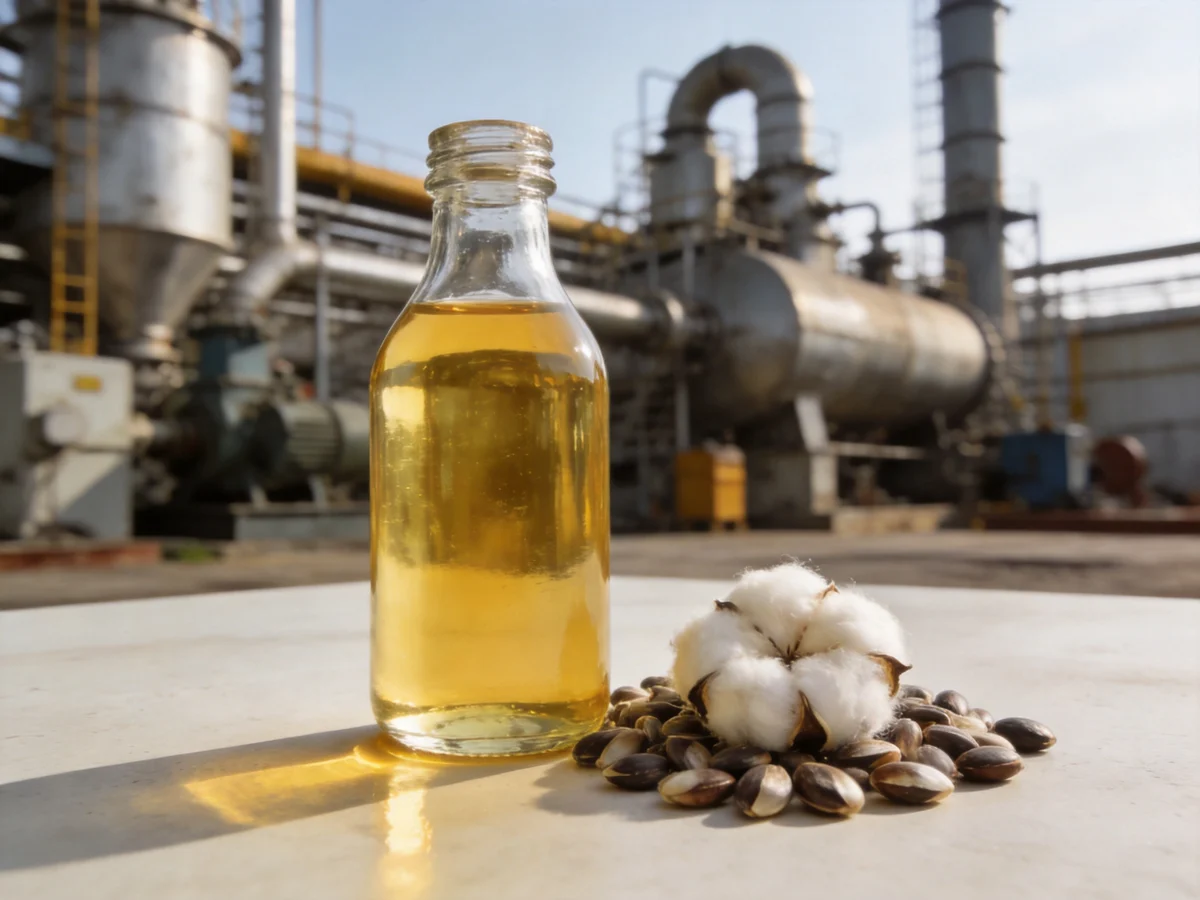
Because the oil lives only in the meats, the whole-seed oil figure understates what the kernel actually holds. On a whole-seed basis, oil content is typically around 18–25%; the meats themselves are considerably richer. This is why front-end cleaning matters so much: every percent of hull or linter that rides into the press dilutes the meats, lowers effective oil yield and adds abrasive, low-value fibre to the system.
~18–25% (typical)
Short cotton fibres — cellulose by-product
Tough fibrous shell — feed / fibre
Oil + protein rich kernel
Incoming seed is first cleaned to remove sticks, sand, metal and field trash, and its moisture is checked. Clean, correctly conditioned seed protects the delinting and dehulling machinery downstream and keeps the meats from being torn up before they reach the press.
Delinting & dehulling: the cottonseed signature
This is the part of the process that belongs to cottonseed alone. It happens in two stages.
Delinting strips the short linter fibres off the seed coat. The recovered linters are a genuine co-product, not waste: they are valued as a source of cellulose and are used in textiles, paper, batting and animal feed, among other outlets. Removing them also keeps fibre out of the oil stream, which would otherwise foul the press and the extractor. Plants typically delint mechanically (and, where practised, chemically) to leave a cleaner seed coat.
Dehulling then cracks the seed and separates the hard hull from the oil-bearing meats. The cracked mixture is screened and aspirated so that light hull fragments are pulled away from the denser meats. Good hull separation is what protects oil quality and yield — too much hull in the meats means lower oil purity and a more abrasive, lower-value flow into the press. The hulls themselves become a fibrous co-product used mainly in animal feed. For a deeper look at how cracking and separation are engineered, see how oilseed dehulling works.
- Delint — remove short linter fibres (cotton by-product).
- Crack — break the hull to expose the meats.
- Separate — screen and aspirate hull away from meats.
- Condition — adjust the cleaned meats for moisture and temperature ready for flaking.
Pressing & extraction: getting the oil out
With clean meats in hand, the line now looks like a conventional high-oil oilseed plant. The meats are flaked between smooth rolls into thin flakes, which dramatically increases surface area and ruptures the oil cells so oil can escape easily. The flakes are then cooked (conditioned) with controlled heat and moisture, which coalesces oil droplets, adjusts plasticity and prepares the material for efficient pressing and extraction.
Because cottonseed meats are oil-rich, most plants use a two-stage recovery route. First, a screw press (expeller) mechanically squeezes out a large share of the oil and produces a partly de-oiled cake. This is the pre-press step. To understand the mechanics of that machine, see how a screw oil press works.
The pre-pressed cake still holds oil that mechanical pressure cannot economically reach, so it goes to solvent extraction. There, a food-grade solvent (typically hexane) washes the residual oil out of the cake, the solvent is recovered by evaporation and condensed for reuse, and the de-oiled solids are desolventized into meal. Solvent extraction is what pushes overall oil recovery to its practical maximum; the full method is covered in how solvent extraction works.
| Step | Purpose | Typical output |
|---|---|---|
| Flaking | Open oil cells, raise surface area | Thin flakes |
| Cooking | Condition moisture & heat for release | Conditioned meats |
| Pre-press (screw) | Mechanically remove bulk of oil | Press oil + cake |
| Solvent extraction | Recover residual oil from cake | Crude oil + meal |
The combined press oil and extracted oil is crude cottonseed oil: dark, cloudy and carrying gums, free fatty acids (FFA) and that natural gossypol pigment. It is nowhere near edible yet — which is where refining comes in.
Gossypol removal: the defining refining challenge
Gossypol is a naturally occurring yellow pigment found in the cotton plant and its seed. It is the main reason crude cottonseed oil is so dark, and it is the reason cottonseed oil must always be refined before it is used as food. The goal of refining a cottonseed oil is therefore not only to remove gums and free fatty acids — it is specifically to remove or bind the gossypol so the finished oil is light in colour and safe as an edible oil.
Two consequences follow from gossypol. First, the caustic neutralizing step is run harder than for a typical soft-seed oil, because the alkali both neutralizes the free fatty acids and reacts with and carries off the gossypol. Second, even after neutralizing, crude cottonseed oil retains more colour than most oils, so it needs heavier bleaching to reach a pale, market-acceptable shade. In short, gossypol dictates the strength of the two colour-controlling steps in the refinery.
Refining: degum, neutralize, bleach, deodorize, winterize
Refining converts crude cottonseed oil into a clear, bland, stable edible oil. The sequence is the standard edible-oil chain, tuned for cottonseed's colour and gossypol. The general framework is described in how to refine edible oil.
- Degumming — hydratable gums (phospholipids) are removed so they don't carry into later steps or harm oil stability.
- Caustic neutralizing — alkali neutralizes free fatty acids and binds gossypol, sending both into the soapstock; this is the key gossypol-removal step. See how oil neutralization works.
- Bleaching — bleaching earth (adsorbent clay) removes residual colour pigments and trace soaps; cottonseed needs a heavier bleach because of its naturally dark crude. See how oil bleaching works.
- Deodorizing — steam stripping under vacuum at high temperature removes odour and flavour compounds and free fatty acid traces, giving a bland, light oil.
- Winterizing (dewaxing) — cottonseed oil contains some solid (saturated) fats that would cloud the oil when cold, so it is chilled and the solids (stearin) are filtered off to give a clear salad oil that stays bright in the refrigerator. See how oil dewaxing works.
Remove phospholipid gums
Cut FFA + bind gossypol
Heavier clay dose for colour
Steam-strip odour & flavour
Not every cottonseed oil goes through every step in the same way — a cooking oil and a clear salad oil have different finishing needs — but the colour-and-gossypol logic of neutralizing plus heavier bleaching is constant. Winterizing is added whenever the product must stay clear cold.
Yield & by-products: little is wasted
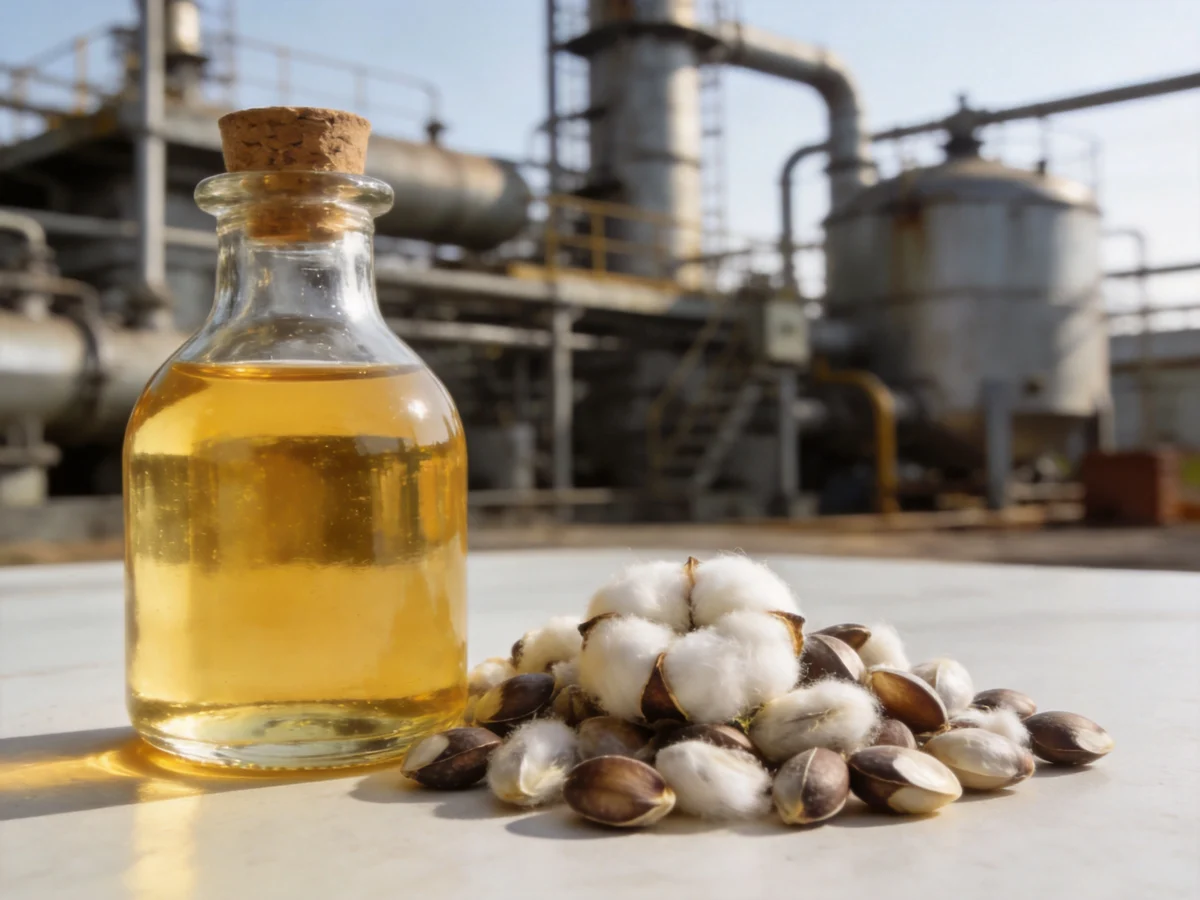
A cottonseed line is, in effect, a fibre-and-oil biorefinery: almost every fraction of the seed finds a market. On a whole-seed basis, expect roughly 18–25% oil (typical), with the balance split between linters, hulls and the protein-rich meal.
| Stream | From | Typical use |
|---|---|---|
| Cottonseed oil | Meats | Edible oil (after refining) |
| Linters | Delinting | Cellulose, textile, batting, feed |
| Hulls | Dehulling | Fibre, animal feed / roughage |
| Cottonseed meal | Extraction | Protein feed (see note) |
| Soapstock / stearin | Refining | By-product fat streams |
One important caveat on the meal: because residual gossypol stays with the protein, untreated cottonseed meal is well suited to ruminant animals (cattle, which tolerate it well) but its use in monogastric animals (such as poultry and pigs) is limited unless the gossypol is reduced. This is the same molecule that drives the refining design — here it simply influences which animals can eat the meal.
Put together, the whole process is a chain of purposeful separations: take the fibre off (linters), take the shell off (hulls), take the oil out (press + solvent), then clean the oil up and strip out the gossypol (refining). Each removal creates either a cleaner main product or a saleable co-product.