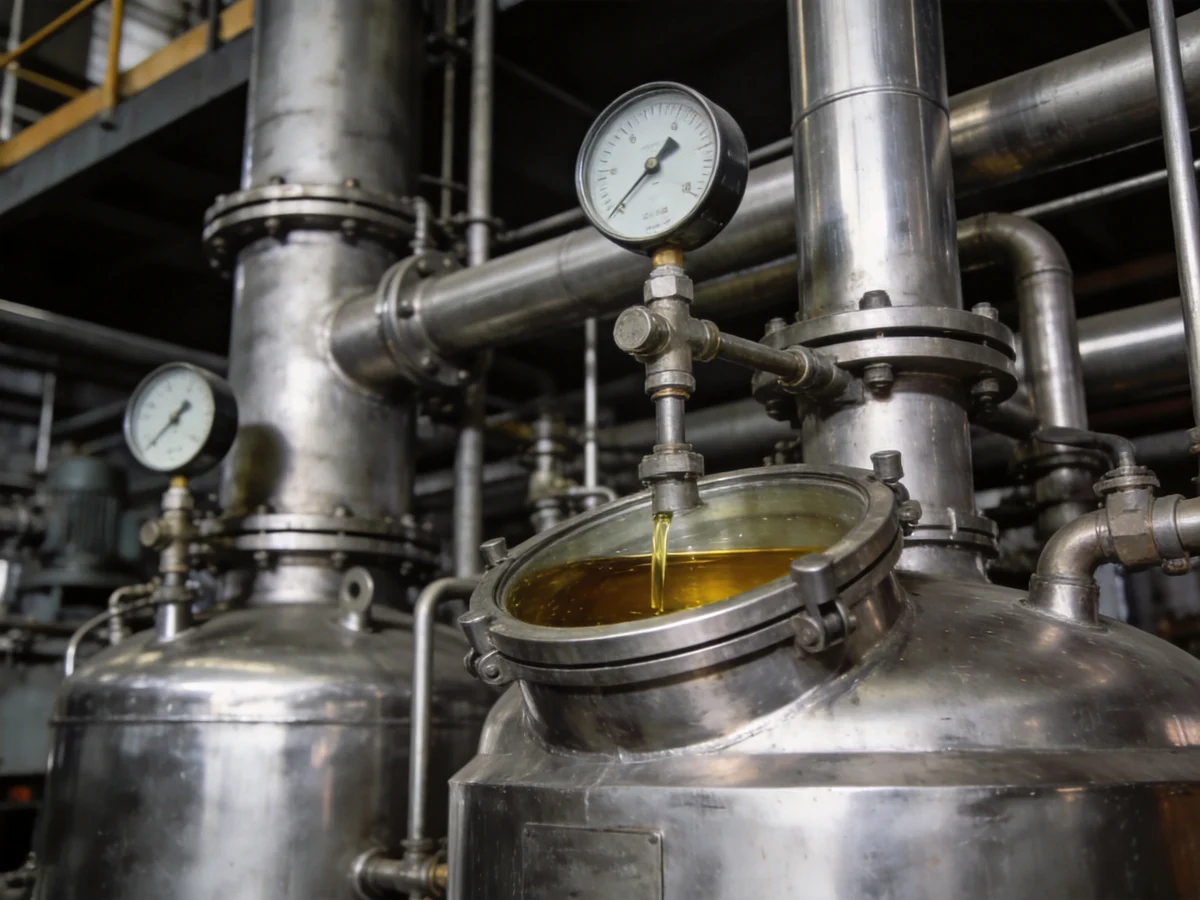
What deodorization is
Deodorization is the final stage of edible oil refining. It is a vacuum steam distillation in which volatile, odor- and flavor-bearing compounds are stripped out of the oil so that the finished product is essentially bland, light in color and odorless. By the time oil reaches the deodorizer it has already been degummed and bleached, so most phospholipids, soaps, metals and color pigments are gone. What remains are the trace compounds that the human nose and palate notice most: aldehydes, ketones, short-chain free fatty acids, pigment decomposition products and oxidation residues. Removing them is what turns a refined oil into a neutral, food-grade cooking or ingredient oil.
The principle is simple physical chemistry. The undesirable volatiles have a much higher vapor pressure than the oil's triglycerides, which are large, heavy molecules. If you raise the temperature and pull a deep vacuum, the small molecules want to leave the liquid while the triglycerides stay behind. A small flow of sparge (stripping) steam bubbled up through the oil sweeps those vapors away and out to the vacuum system, the same way a distillation carrier gas works.
Why oil is deodorized
Crude and even bleached oils carry off-odors and off-flavors that make them unacceptable to consumers and food manufacturers. Deodorization targets several groups of compounds at once:
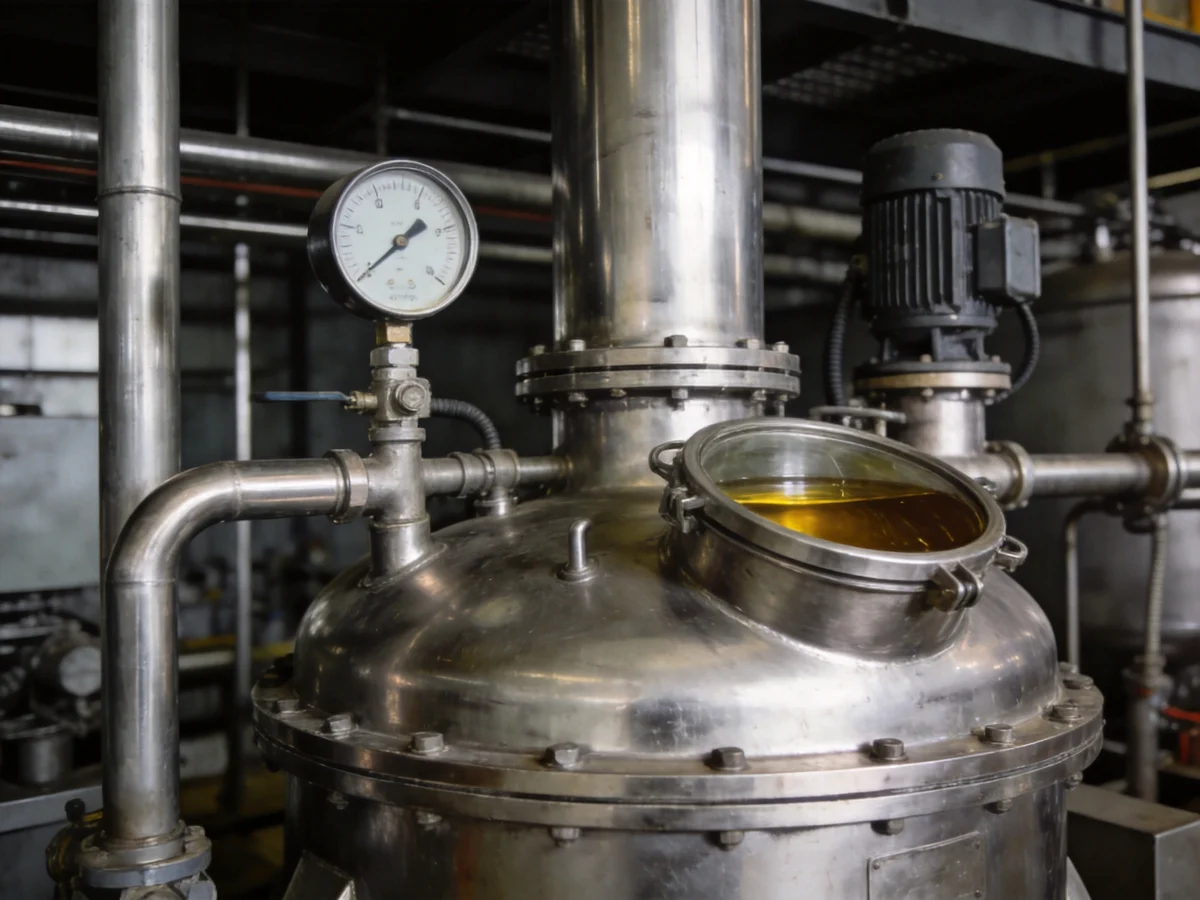
- Volatile odor and flavor compounds — aldehydes, ketones, hydrocarbons and other low-molecular-weight species responsible for grassy, beany, fishy or rancid notes.
- Residual free fatty acids (FFA) — short-chain acids contribute sharp flavors; in physical refining the bulk of FFA is also removed here.
- Pigment decomposition products — heat-bleaching of carotenoids and other colorants left after the bleaching step, which lightens the oil further.
- Peroxides and secondary oxidation products — stripping them improves oxidative stability and shelf life.
The result is an oil that tastes of almost nothing, which is exactly what is wanted for a neutral frying or salad oil. A good deodorizer therefore does three jobs together: it deodorizes, it lightens color, and — in physical refining — it deacidifies.
How steam stripping under vacuum works
Steam stripping under high vacuum is the heart of the process. Three conditions act together:
Typically ~240-260°C (palm sometimes to ~270°C). Higher temperature raises the vapor pressure of the volatiles and FFA so they leave the oil faster.
Typically ~2-4 mbar (often quoted as ~1.5-5 mbar). A deep vacuum lowers boiling points, lets stripping run at a safer temperature and protects the oil from oxidation by excluding air.
Typically ~0.5-2% of the oil weight. Direct steam injected into the oil increases the vapor-liquid contact area and carries volatiles to the vacuum system.
Typically ~30-90 min of retention at temperature, balancing thorough stripping against heat damage to the oil.
Because vacuum lowers the effective boiling point of every compound, deodorization can run at a temperature that strips the volatiles efficiently while keeping the triglycerides intact. The deeper the vacuum, the lower the temperature (or the less stripping steam) needed for the same result — which is why vacuum performance is the single biggest lever on both product quality and steam consumption. Without enough vacuum, operators are forced to push temperature and time up, and that is precisely where unwanted reactions begin.
Process steps inside the deodorizer
A modern deodorizer is a sequence of operations rather than a single tank. The bleached, filtered oil passes through:
- Heat recovery and deaeration — incoming oil is deaerated under vacuum to remove dissolved oxygen, then pre-heated by recovering heat from the hot deodorized oil leaving the system, which saves energy.
- Final heating — a high-pressure steam or thermal-fluid heater brings the oil up to the deodorizing temperature (~240-260°C).
- Stripping and retention — the hot oil flows over trays, through a packed column or into stripping/retention vessels where sparge steam contacts it under high vacuum for the holding time, carrying off volatiles and FFA.
- Vapor scrubbing — the stripped vapors pass to a scrubber/condenser where the distillate is recovered before the non-condensables reach the vacuum unit.
- Cooling, additives and polishing — the oil is cooled under vacuum to avoid re-oxidation, dosed with citric acid and/or antioxidant for stability, then polish-filtered to a clear, finished oil.
Designs differ — batch, semi-continuous and continuous (tray or packed-column) systems all exist — but every one delivers the same combination of heat, vacuum, steam and residence time.
Key operating parameters
The table below summarizes typical, approximate operating windows. Exact values are set by the oil type, the feed quality and the refining route (chemical vs. physical).
| Parameter | Typical range | Effect / notes |
|---|---|---|
| Temperature (soft oils) | ~240-255°C | Soybean, sunflower, rapeseed, cottonseed |
| Temperature (palm) | up to ~260-270°C | Higher to strip its higher FFA in physical refining |
| Operating vacuum | ~2-4 mbar | Deeper vacuum = lower temperature / less steam |
| Sparge steam | ~0.5-2% of oil | More steam improves stripping, raises utility cost |
| Holding / stripping time | ~30-90 min | Longer strips more but risks heat damage |
| Finished FFA (physical) | low, typically <0.1% | FFA stripped here instead of caustic neutralizing |
These figures should be read as typical, approximate starting points. The art of deodorization is choosing the lowest temperature and shortest time that still hit the flavor, color and FFA targets — because every extra degree and every extra minute trades quality for throughput.
Physical refining vs. chemical refining
There are two routes to a refined oil, and deodorization plays a larger role in one of them.
Free fatty acids are neutralized earlier with caustic soda, forming soapstock that is removed before bleaching. Deodorization then mainly handles odor, flavor and color.
No caustic neutralization. The free fatty acids are instead stripped out during deodorization itself — the same steam-distillation step that removes odors also performs deacidification.
Physical refining is attractive for higher-FFA oils such as palm because it avoids the oil losses and effluent of caustic neutralization, and it concentrates the FFA into the distillate as a recoverable product. Its trade-off is that the deodorizer must run hot enough to strip a larger acid load, which raises the importance of good vacuum and tight temperature control. This is why physical-refining deodorizers are typically run at the upper end of the temperature window and rely on excellent vacuum performance.
Deodoriser distillate as a by-product
Everything stripped off the oil condenses in the scrubber as deodorizer distillate (DOD). Far from being waste, it is a valued co-product. It is rich in:
- Free fatty acids — the dominant fraction, especially from physical refining of high-FFA oils.
- Tocopherols (vitamin E) — natural antioxidants recovered for the food and supplement industries.
- Sterols and squalene — used in nutraceuticals, cosmetics and oleochemicals.
Because of the tocopherol and sterol content, distillate is sold on for further fractionation and recovery rather than discarded. Capturing it efficiently improves both the economics and the environmental footprint of the refinery; the actual market value depends on composition and demand and is qualitative here.
Quality and safety: the heat-sensitivity trade-off
Deodorization is a balancing act. The same heat that strips odors can, if pushed too far, create new problems:
Excessive temperature and time can isomerize cis double bonds into trans configurations. Keeping temperature and retention controlled minimizes trans formation.
These process contaminants form mainly above ~230-240°C from chloride precursors. Modern practice limits peak temperature and time to suppress them.
Modern good practice therefore favors dual-temperature deodorization and tight retention control: a higher temperature for a short stripping period to remove FFA and odors efficiently, followed by a lower-temperature holding stage for the heat-thermal-bleaching and final polishing, so the oil spends as little time as possible at the most damaging temperatures. Combined with good feed quality (low chlorides) and effective vacuum, this keeps trans fats and 3-MCPD/glycidyl esters low while still delivering a fully deodorized oil. The lesson is consistent: the lowest temperature and shortest time that meet the targets are always the right setpoints.
Common problems and how to avoid them
- Residual odor or flavor — usually too low a temperature, too little stripping steam or poor vacuum; verify the vacuum system and steam flow before raising temperature.
- High trans / 3-MCPD — temperature or holding time too high; reduce peak temperature, shorten retention and check chloride levels in the feed.
- Color reversion — oxygen pickup during cooling or storage; cool under vacuum, dose citric acid, and blanket with nitrogen.
- Poor distillate recovery — inadequate scrubber or condenser; review the vapor-handling design.
- Oxidative instability — air ingress or skipped antioxidant dosing; ensure deaeration and proper additive injection at the cooling stage.
Most issues trace back to one of the four levers — temperature, vacuum, steam and time — or to oxygen contact. Getting the vacuum system right is almost always the highest-leverage fix because it lets every other parameter run gentler.