
What Solvent Extraction Is
Solvent extraction (also called leaching) is the process of dissolving the oil out of an oilseed using a liquid solvent rather than squeezing it out under mechanical pressure. In a vegetable oil mill it is the high-efficiency finishing stage of oil recovery: where a screw press leaves a meaningful fraction of the oil locked inside the cake, an extractor washes that oil away with food-grade hexane until almost none remains. The result is two product streams — a miscella (oil dissolved in solvent) that becomes crude oil, and a low-oil meal that becomes animal feed or protein raw material.
Because of its efficiency, solvent extraction is the dominant industrial route for recovering oil from low-oil seeds such as soybean, and the second-stage route for high-oil seeds such as sunflower, rapeseed and cottonseed after pre-pressing. Understanding it is essential for any oil-mill investor or process engineer specifying a complete production line.
How It Works: The Leaching Principle
Solvent extraction is fundamentally a mass-transfer operation. When hexane contacts a thin oilseed flake or a porous collet, the oil inside the cellular structure dissolves into the surrounding solvent because oil and hexane are mutually soluble. The oil migrates from where its concentration is high (inside the particle) to where it is low (the fresh solvent), driven by the concentration gradient, until the two approach equilibrium.
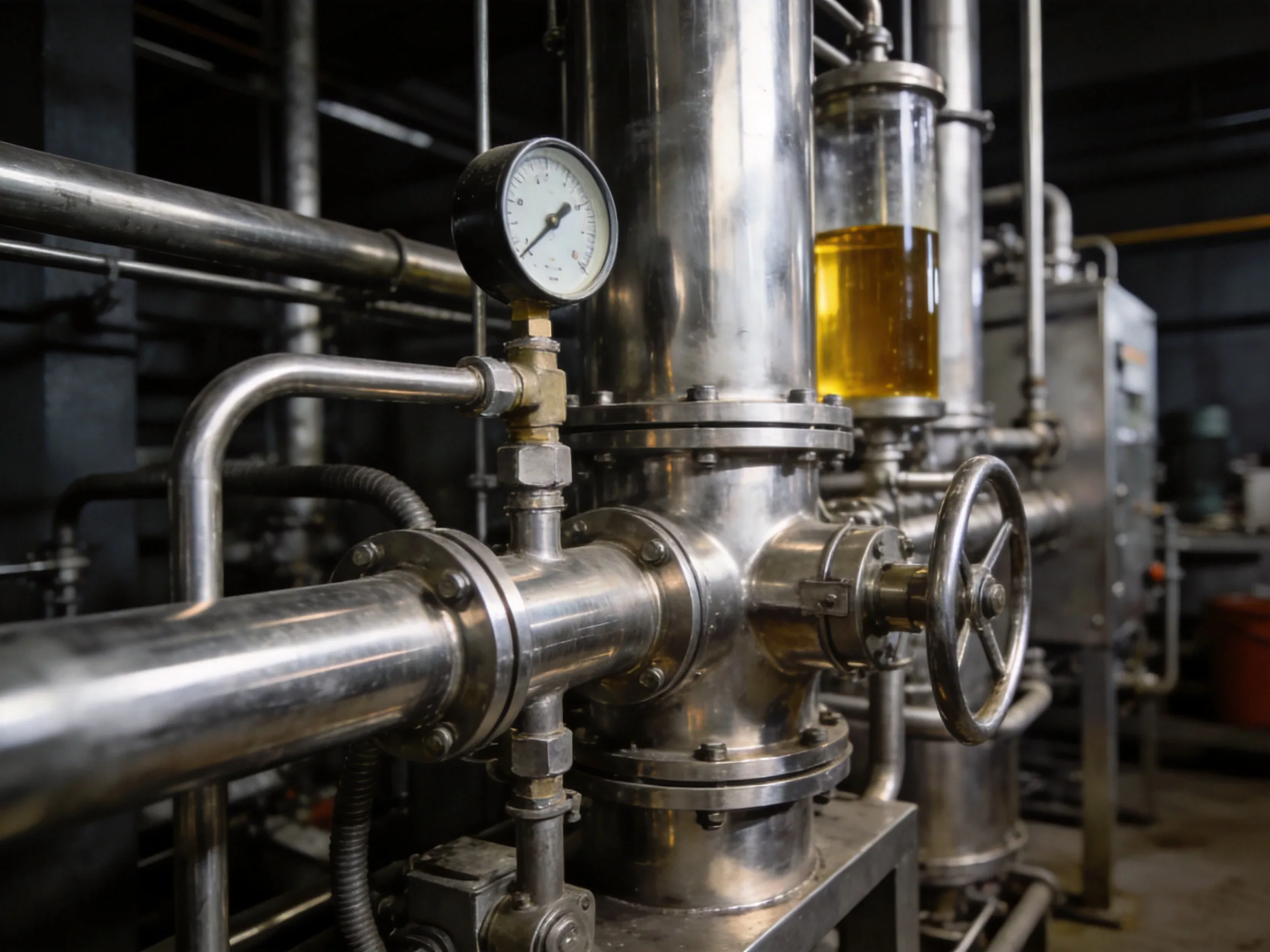
To keep that gradient strong, modern extractors work counter-currently: the most oil-depleted material meets the freshest, leanest solvent, while the incoming oil-rich material is washed by solvent that is already partly loaded. This staged washing maximises the amount of oil pulled out for each kilogram of solvent circulated. The oil-laden solvent that drains from the bed is the miscella; the washed solids are the spent, solvent-wet meal.
Two physical mechanisms dominate. In percolation, solvent is sprayed onto a bed of material and trickles down through it by gravity. In immersion, the material is submerged in flowing solvent. Many real designs combine both. In every case, the geometry of the feed particle is critical — the solvent has to reach the oil and the miscella has to drain away freely.
The single biggest lever on extraction performance is feed preparation. A well-made flake or collet gives the solvent short diffusion paths and a freely draining bed; a poorly prepared feed traps oil and chokes drainage no matter how good the extractor is.
The Solvent: Why Hexane
The industry standard solvent is food-grade commercial hexane, a narrow petroleum fraction boiling at roughly 63–69°C. It is favoured because it dissolves vegetable oil readily while barely dissolving water, proteins, carbohydrates or minerals — so it lifts the oil cleanly and leaves the meal's nutritional value intact. Its low boiling point means it can be evaporated out of both the oil and the meal at modest temperatures, and then condensed and reused, so net consumption is small.
Hexane's main drawback is that it is highly flammable and its vapour forms explosive mixtures with air. This single property shapes the entire plant: the extraction building, the equipment and the electrics are all designed to contain solvent and exclude ignition sources. Extraction temperature is held around 50–55°C — warm enough to keep oil viscosity low and speed dissolution, but safely below the solvent's boiling point so the extractor stays liquid-full and sealed.
The Process Steps
Whole or pre-pressed seed is never fed directly. Cleaned, dehulled and conditioned seed is cracked and rolled into thin flakes, or processed through an expander into porous collets. This ruptures the oil cells, shortens the path the solvent must travel, and creates a permeable bed. High-oil seeds are usually pre-pressed first, so that only the residual oil in the cake needs to be extracted.
The prepared material enters the extractor and is washed counter-currently with hexane. Over a residence time of typically 30–60 minutes, successive stages of miscella and fresh solvent draw the oil out until the solids hold only a small fraction of a percent of oil.
The oil-rich miscella drains from the bed and is collected, usually filtered to remove fine solids (fines), and held for distillation. A typical full miscella might carry on the order of a quarter to a third oil, the balance being solvent.
The miscella is heated so the hexane evaporates away from the oil. This is done in stages — evaporators to remove the bulk of the solvent, then a stripping column where steam carries off the last traces — leaving crude oil ready for refining. The evaporated hexane is sent to the condensers.
The solvent-wet meal passes to a desolventiser-toaster (DT), where direct and indirect steam heat the meal to evaporate the hexane and simultaneously toast it for feed quality. All the evaporated solvent — from the meal and from miscella distillation — is condensed back to liquid, separated from water, and returned to the extractor. Net solvent loss is held to a few kilograms per tonne of material processed.
Key Equipment
A solvent extraction plant is an integrated solvent loop rather than a single machine. The core unit operations are:
Upstream of all this sits the seed preparation equipment — cleaners, crackers, conditioners, flaking rolls and expanders — whose output quality largely determines extraction performance.
Key Parameters
The figures below are typical ranges for vegetable oil extraction. Real targets vary with seed type, preparation, plant design and product specification, and should be confirmed for each project.
| Parameter | Typical value | Why it matters |
|---|---|---|
| Solvent | Food-grade hexane, b.p. ~63–69°C | Dissolves oil cleanly, evaporates & recovers easily |
| Extraction temperature | ~50–55°C | Low oil viscosity, fast dissolution, below boiling point |
| Residence time | ~30–60 min | Time for oil to diffuse out of the particle |
| Residual oil in meal | Typically <1% | Measure of extraction completeness |
| Solvent loss | A few kg per tonne | Drives operating cost and emissions |
The headline number is residual oil in the meal. Pushing it below 1% is what justifies the complexity of an extraction plant; a well-run line recovers almost all of the available oil that pressing alone would leave behind.
Solvent Extraction vs Mechanical Pressing
Pressing and extraction are complementary, not competing, technologies. A screw oil press recovers oil mechanically and is simple, robust and inherently safe, but it cannot remove all the oil — press cake typically still holds 16–20% oil. Solvent extraction takes that residual oil down below 1%, but at the cost of a large, flammable, capital-intensive plant.
| Aspect | Mechanical pressing | Solvent extraction |
|---|---|---|
| Oil left in residue | ~16–20% (press cake) | Typically <1% (meal) |
| Capital & complexity | Lower, modular | High, integrated plant |
| Safety | No flammable solvent | Flammable hexane, ATEX design |
| Best suited to | Small / medium throughput, niche oils | Large throughput, low-oil & pre-pressed seeds |
For low-oil seeds like soybean, direct extraction is the norm. For high-oil seeds, the standard solution is pre-press plus extraction: a press first removes the bulk of the oil, and extraction recovers the rest from the cake. Because an extraction plant carries high fixed costs, it only pays off at large, steady throughput — smaller operations often start with pressing and add extraction as volumes grow. To compare press types, see screw press vs hydraulic press, and to see where extraction sits in the whole chain, review the complete oil production flow.
Safety & Cost Considerations
Hexane's flammability dominates the design and economics of any extraction plant. The entire facility is built as a hazardous area: equipment is sealed and inerted, the building is naturally ventilated, electrics are explosion-proof (ATEX-rated), and continuous gas detection guards against leaks. Strict procedures govern start-up, shutdown and maintenance to keep solvent vapour away from any ignition source.
These requirements, together with the multiple unit operations and solvent recovery loop, make extraction a high-capital, large-footprint investment. It rewards scale: the more tonnes that pass through, the lower the cost per tonne of recovered oil. That is the core reason extraction is reserved for high-throughput operations and is so often paired with a pre-press front end, while standalone small mills rely on pressing. Note that crude solvent-extracted oil always requires refining — see how to refine edible oil and the oil refining process — before it is fit for food use.
Common Problems
Most extraction troubles trace back to a handful of recurring issues:
- Poor flake or collet quality. Flakes that are too thick, fines that blind the bed, or collets that crumble all slow solvent penetration and miscella drainage, raising residual oil. The fix almost always lies upstream in seed preparation, not the extractor.
- High residual oil in the meal. Caused by short residence time, low solvent-to-solids ratio, channelling in the bed, or low temperature. Restoring even washing and adequate contact time brings residual oil back under target.
- Excessive solvent loss. Driven by incomplete desolventising of the meal, condenser or vent-recovery inefficiency, or leaks. It hits both operating cost and emissions, so the recovery system and seals warrant constant monitoring.
Planning an extraction or pre-press line? SinoOil designs complete vegetable oil plants — from seed preparation and pressing through solvent extraction and refining. Use our capacity calculator to size your line, or start a free plant design tailored to your seed and throughput.