
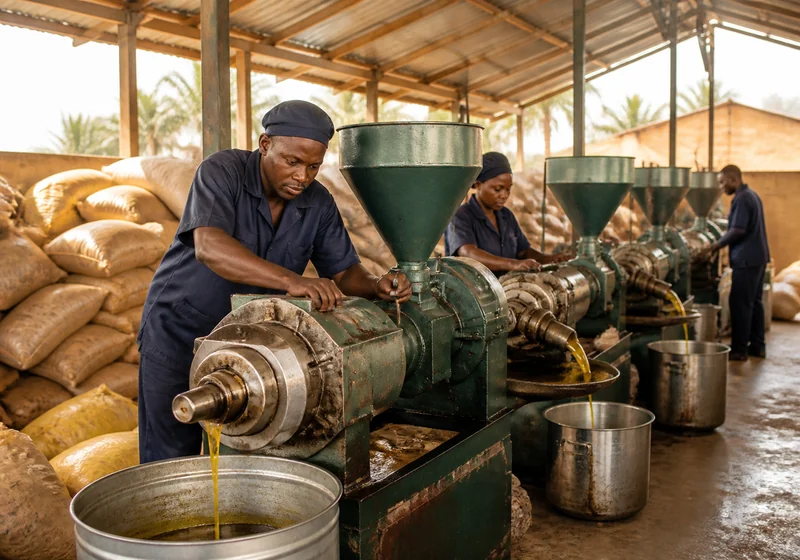
30 TPD Soybean Oil
Processing Plant — Nigeria
Full turnkey soybean oil processing plant in Kano State — from seed cleaning through pressing to refined bottled oil. Complete case study with equipment list, process flow, oil yield data, and client feedback.
The Challenge
A commercial agro-food company in Kano State, Nigeria had been operating a noodle manufacturing business for four years. Their primary input cost was refined soybean cooking oil, which they purchased from Lagos-based wholesalers at significant markups — roughly ₦1,200–1,500/litre delivered to site.
Northern Nigeria produces substantial quantities of soybean — Kano, Kaduna, and Benue states together yield over 600,000 tonnes annually. The client's factory sits within 80 km of active soybean farms, yet they were paying wholesale imported-oil prices instead of processing locally. They approached SinoOil Machinery with a brief: "We want to process our own soybean oil. We have 800 m² of floor space. What can you do?"
The core engineering challenge was designing a 30 TPD full-process line that could fit within their existing building footprint, operate with the local 415V / 50Hz power supply (which experiences regular fluctuations), produce food-grade refined oil without a large steam boiler, and be operated by a local team of 6–8 workers after 7 days of training.
How We Solved It
SinoOil designed a compact modular layout in a single-aisle 800 m² footprint. We used four 6YL-180 screw oil presses in parallel rather than a single large press — this reduced individual machine size, allowed one press to be offline for maintenance without stopping production, and matched the available floor width.
For refining, rather than a continuous refinery (which requires a larger steam boiler and more floor space), we specified a 3T/batch modular refinery system — degumming, neutralizing, washing & dehydration, bleaching, and deodorizing in discrete tanks. This approach uses a compact steam generator (300 kg/h capacity) rather than an industrial boiler, reducing both capital cost and operator complexity.
A voltage stabiliser and soft-start units were added to all motors to protect equipment from the local power fluctuations. The PLC control panel was simplified to a human-machine interface (HMI) touchscreen with Hausa-language labels for local operator accessibility.
Processing Line Flow
Seed-to-oil full process — 8 stages from raw soybean to food-grade refined oil
The batch refinery follows the standard DNBWD sequence: Degumming (hydration, removes phospholipids), Neutralizing (NaOH wash, removes free fatty acids), Bleaching (activated earth, removes colour pigments), Washing & dehydration (removes soap residue), Deodorizing (steam stripping, removes odour compounds and peroxides). Output meets Nigerian NAFDAC food-grade standards.
What Was Installed
Complete equipment specification for the 30 TPD Kano State soybean oil processing plant
| # | Equipment | Model | Qty | Notes |
|---|---|---|---|---|
| 1 | Vibrating seed cleaning screen | TQLZ80 | 1 | Removes impurities, broken seeds, dust |
| 2 | Bucket elevator | TDTG50/23 | 2 | Vertical conveying between stages |
| 3 | Screw conveyor | TLSS25 | 3 | Horizontal material transfer |
| 4 | Conditioner / cooker | LYZF1.0 | 1 | Steam conditioning to 110–115°C before pressing |
| 5 | Screw oil press | 6YL-180 | 4 | Main pressing, 7–8 TPD each, 2.2% residual oil in cake |
| 6 | Plate and frame filter press | BASY-500 | 1 | 500L capacity, removes suspended particles from crude oil |
| 7 | Crude oil storage tank | — | 2 | 5T each, carbon steel with epoxy lining |
| 8 | Degumming tank | DG-3000 | 1 | 3T batch, hot water degumming |
| 9 | Neutralizing tank | NT-3000 | 1 | NaOH treatment, FFA removal |
| 10 | Washing & dehydration tank | WD-3000 | 1 | Soap residue removal + vacuum dehydration |
| 11 | Bleaching tank | BL-3000 | 1 | Activated bleaching earth, colour removal |
| 12 | Deodorizing tank | DO-3000 | 1 | Steam stripping under vacuum, odour/peroxide removal |
| 13 | Vacuum pump system | 2BV-5131 | 1 | Water-ring vacuum pump, −0.096 MPa |
| 14 | Steam generator (boiler) | WNS-0.3 | 1 | 300 kg/h, natural gas / LPG fired |
| 15 | PLC control panel | — | 1 | Siemens S7-1200 PLC, HMI touchscreen, Hausa labels |
| 16 | Voltage stabiliser | SVC-100KVA | 1 | Protects motors from grid fluctuations |
| 17 | Refined oil storage tank | — | 2 | 10T each, stainless steel 304 |
Results After Commissioning
Measured performance data from the first 6 months of operation (Sept 2024 – Feb 2025)
"The commissioning engineer was professional and very patient with our operators. The team learned the process in about 4 days. We have been running now for 7 months without any major issues. The oil yield is actually better than what they promised — we are consistently getting 18.5% from our local Kano soybean. Our production cost is about 40% less than what we were paying before. We are already planning to expand to 50 TPD."— Production Manager, Agro-food Company, Kano State, Nigeria | September 2024
Soybean Oil Plant Questions
Technical questions about soybean oil processing and this specific project
Using screw press technology, soybean oil yield is typically 17–19% by weight. The Kano State plant achieved 18.5% on locally grown soybean. Solvent extraction achieves higher yields (18–22%) but requires a larger investment and more technical expertise. Actual yield depends on soybean moisture content (optimal 10–12%), oil content of the specific variety, and processing temperature (conditioning temperature 110–115°C).
A 30 TPD soybean oil plant with complete turnkey configuration (cleaning, conveying, 4 screw presses, filter, batch refinery, storage tanks, PLC control) costs approximately $55,000–$75,000 FOB China. Shipping and insurance to West Africa adds $3,000–$5,000. On-site installation and commissioning by our engineers is included. Contact us for a precise quotation based on your exact specifications.
Total timeline from order to first oil: 35–45 days manufacturing, 25–30 days sea freight to West Africa, 7–10 days on-site installation and commissioning — approximately 70–90 days. The Kano project was commissioned in 7 days on site. Our engineer stays until all equipment is running stably and operators are fully trained.
The Kano client achieved approximately 40% reduction in oil input cost compared to purchasing refined oil from wholesalers, with an estimated 18-month payback period. Profitability depends on the local soybean purchase price vs. refined oil selling price, operating costs (labour, utilities, packaging), and plant utilisation rate. We recommend running a financial model based on your local market prices before investment — our team can help with this analysis for free.
Soybean press cake contains approximately 40–45% protein and 2–3% residual oil. It is a high-value animal feed ingredient sold to poultry and livestock farms. In Nigeria, the Kano client sells their press cake directly to local poultry farms at ₦180–220/kg. This by-product revenue significantly improves the overall project economics. For clients near livestock farms, the cake sale can offset 15–20% of total operating costs.
Similar Project in Mind?
Tell us your raw material, capacity, and country — we'll design the plant layout and send a detailed quotation within 24 hours