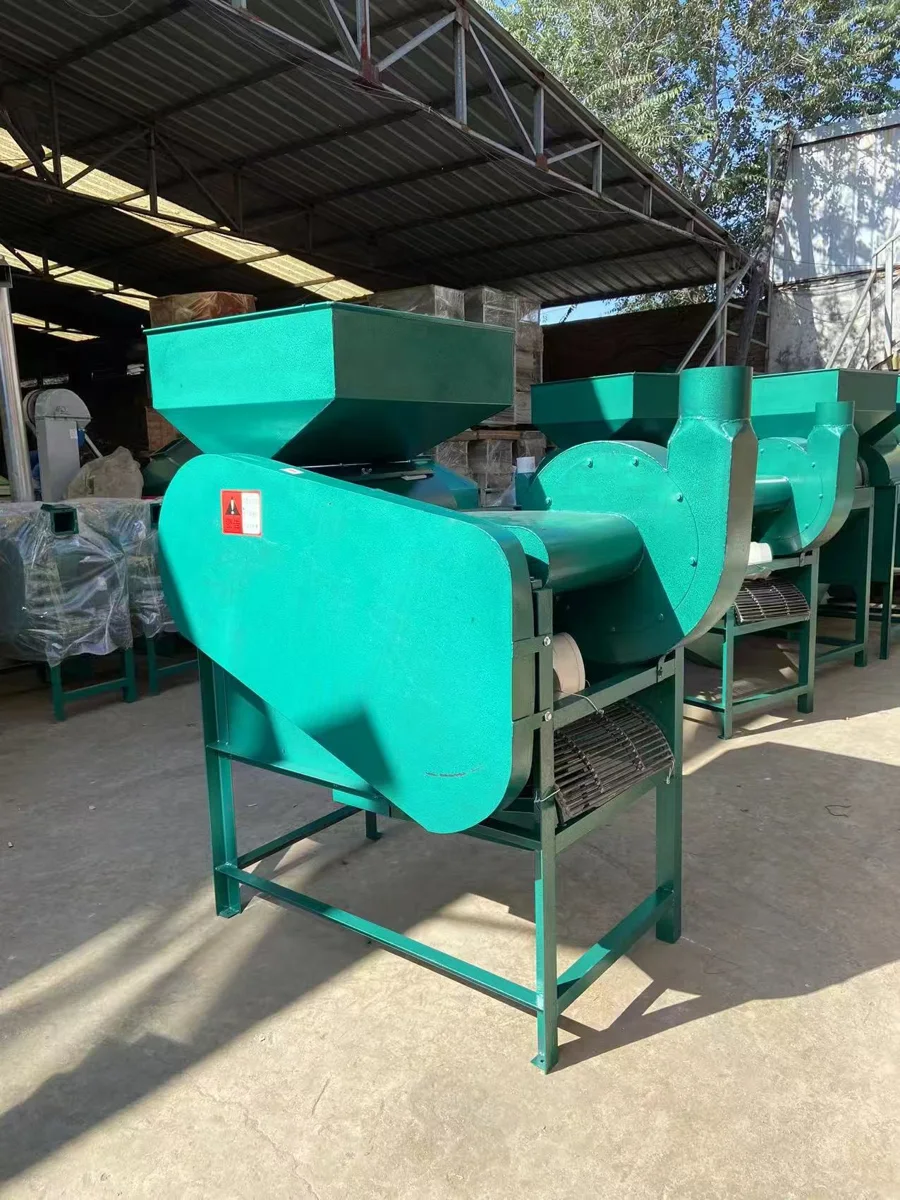
 The process starts at the feed hopper, which meters in-shell peanuts into the shelling chamber at a steady rate. Inside, a rotating rotor works against a curved concave screen. The gap between rotor and screen is sized so shells are cracked by rubbing and gentle impact, while the softer kernels pass through largely intact.
Once cracked, the mixture of kernels and shell fragments drops onto the screen below. Kernels, being heavier and denser, fall through the screen openings. At the same time, an integrated fan generates an air stream that blows the light, papery shell fragments out through a separate shell outlet — on a well-designed peanut shelling machine, this outlet can rotate 360 degrees so shells can be discharged in any direction that suits your floor layout.
Peanuts are not uniform: pod size varies by variety, region and season. That is why quality shellers ship with interchangeable or adjustable screens. A screen with openings too large lets unshelled pods through; too small, and kernels get scratched or jammed. Matching the screen to your peanut size is the single biggest adjustment an operator makes.
Airflow is the second tuning point. Too weak, and shell pieces contaminate the kernel stream; too strong, and small kernels get blown out with the waste. Properly set up, industry equipment typically reaches 95–98% shelling rates with only 2–5% kernel breakage in a single pass — the same separation principle used across the wider family of seed dehulling machines.
Even a perfectly adjusted machine performs poorly if peanut moisture is wrong. The ideal range for shelling is approximately 8–13% moisture. Overly dry peanuts produce brittle kernels and high breakage; overly wet peanuts shell sluggishly and clog screens.
A practical winter trick used in many mills: spray roughly 10 kg of warm water over each 50 kg of peanuts, cover them with plastic film for about 10 hours so moisture equalizes, then sun-dry for around 1 hour before shelling. This simple conditioning step often does more for kernel quality than any machine setting.
Shells absorb oil during pressing, so leaving them in the feed directly lowers your oil yield. They are also abrasive, accelerating wear on screw press components. Removing shells first therefore raises oil recovery and extends press life — which is why shelling sits at the front of every well-designed seed preparation line, usually after a seed cleaning machine removes stones and debris.
Sheller capacity should match your press throughput with some headroom. SinoOil Machinery's peanut shelling machine range covers small to mid-size mills: the 60 type handles 300–400 kg/h, the 80 type 400–600 kg/h, and the 100 type 800–1,000 kg/h, all with all-copper motors and approximately 95% single-pass shelling at ≤5% breakage. Manufacturing factory-direct since 2009 and exporting to 80+ countries under ISO9001, CE and SGS certification, SinoOil can size a sheller — or a complete preparation line — for your project. Contact our engineers for a quotation.
Properly adjusted machines typically achieve 95–98% shelling in a single pass with 2–5% kernel breakage, provided peanut moisture is in the ideal 8–13% range and the screen size matches the pod size.
The most common cause is peanuts that are too dry, which makes kernels brittle. Conditioning them toward 8–13% moisture, reducing rotor speed if adjustable, and fitting the correct screen size usually brings breakage back down to typical levels.
Yes, as long as it has interchangeable or adjustable screens. Operators swap screens to match larger or smaller pods; running mixed sizes on one screen lowers shelling rate and raises breakage.
Strongly recommended. Shells absorb oil during pressing, lowering yield, and their abrasiveness wears screw press parts faster. Shelling first improves oil recovery and protects downstream equipment.
SinoOil engineers size the right pretreatment equipment for your capacity — free plant design included.
Get Engineering Support →