
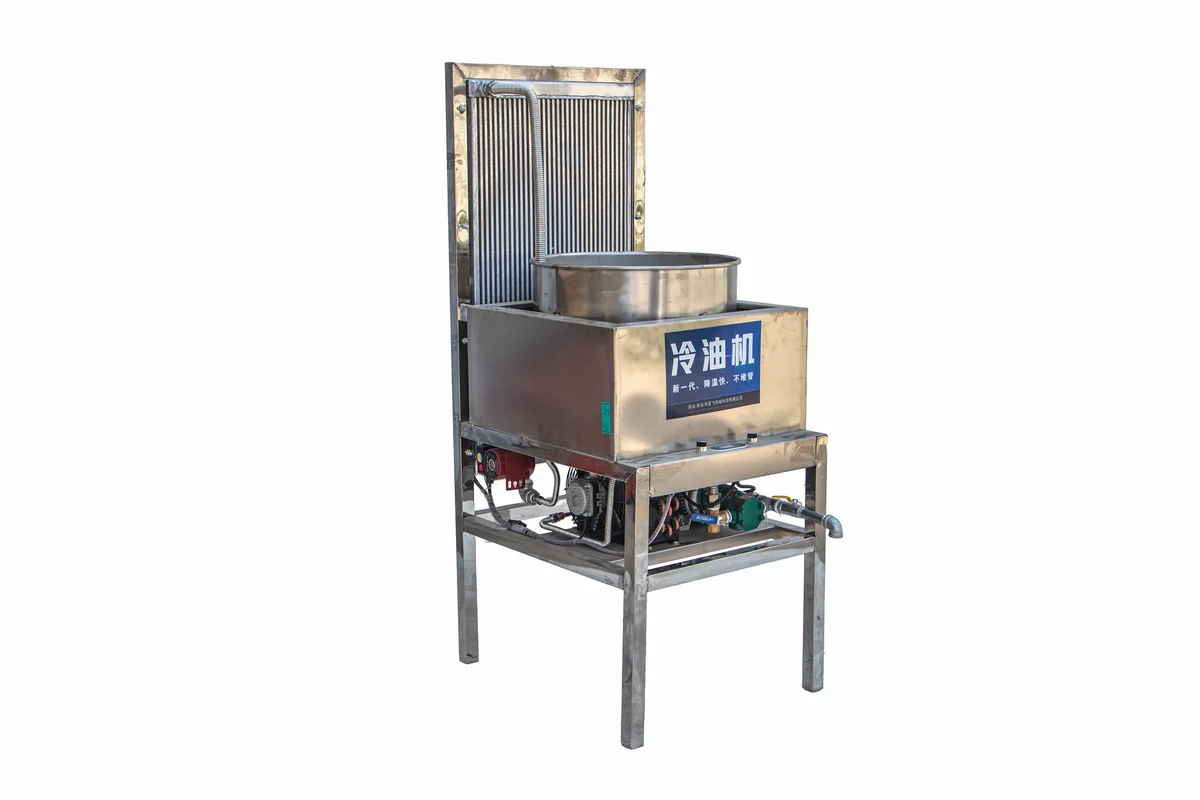
Single-Stage vs Dual-Stage Oil Cooler
Choose by inlet temperature, target outlet temperature, batch size, ambient conditions and available cooling utilities—not by stage count alone.
SinoOil factory demonstration · oil cooling
See the water and air cooling paths in one dual-mode unit
The selection question is whether one heat-rejection method is sufficient. This walkthrough exposes both paths in the shown machine: a water reservoir and condenser plus a finned radiator and fan.
What to watch:
- Water-cooling reservoir and condenser section
- Air-cooling radiator and fan section
- Pump and circulation connections beneath the vessel
Source: SinoOil Machinery official YouTube channel. The footage shows one dual-mode cooler; it does not prove cooling time or outlet temperature for every batch. Confirm inlet temperature, oil mass, ambient conditions, water supply and acceptance criteria.
Start with the process duty
The reviewed single-stage configuration uses a tank and fan-cooled heat-exchange arrangement. The reviewed dual-stage configuration combines air cooling with a water-cooling stage. Actual duty depends on the selected heat exchangers, flow rate and site conditions.
Engineering note: Final ratings, materials, utilities and operating limits must be confirmed in the current technical agreement for the supplied machine.
Decision matrix
| Decision | Single-stage | Dual-stage |
|---|---|---|
| Cooling arrangement | Fan/air-cooled circulation arrangement | Air cooling plus water-cooling stage |
| Utilities | Electricity and ventilation | Electricity, ventilation and suitable cooling-water circuit |
| Project fit | Moderate cooling duty where air cooling is sufficient | Higher cooling duty or lower target temperature when water is available |
| Site sensitivity | Ambient temperature and airflow | Ambient temperature, water temperature, flow and quality |
| Must confirm | Inlet/outlet temperature, batch and ambient design point | Inlet/outlet temperature, batch, ambient and cooling-water design point |
Practical checklist
Cooling data the supplier needs
- Oil type and viscosity
- Inlet and required outlet temperature
- Batch volume or continuous flow
- Ambient summer temperature
- Cooling-water temperature and availability
- Required cooling time
Operating cautions
- Use a confirmed pump and piping arrangement
- Keep heat-transfer surfaces clean
- Do not promise outlet temperature without a heat-load calculation
- Check that water and oil circuits cannot cross-contaminate